

In 2026, most land professionals are already using AI. The problem is what their AI is working with.
ChatGPT, Claude, and Microsoft Copilot have quietly become part of the daily workflow for developers, planners, and land agents across the UK. Drafting appraisals, summarising planning documents, comparing sites — AI handles it faster than anyone could manually.
But there's a fundamental flaw in how most people are using these tools, and it's costing them time and credibility.
Your AI assistant doesn't have access to real data. When you ask it about planning constraints on a specific site, it gives you a confident answer. When you ask who owns a parcel of land, it tells you with certainty. When you ask why an application was refused, it explains the reasoning clearly.
Most of the time, it's making it up.
This isn't a criticism of AI. It's how large language models work - they generate plausible language, not verified facts. And in property development, plausible-but-wrong costs real money.
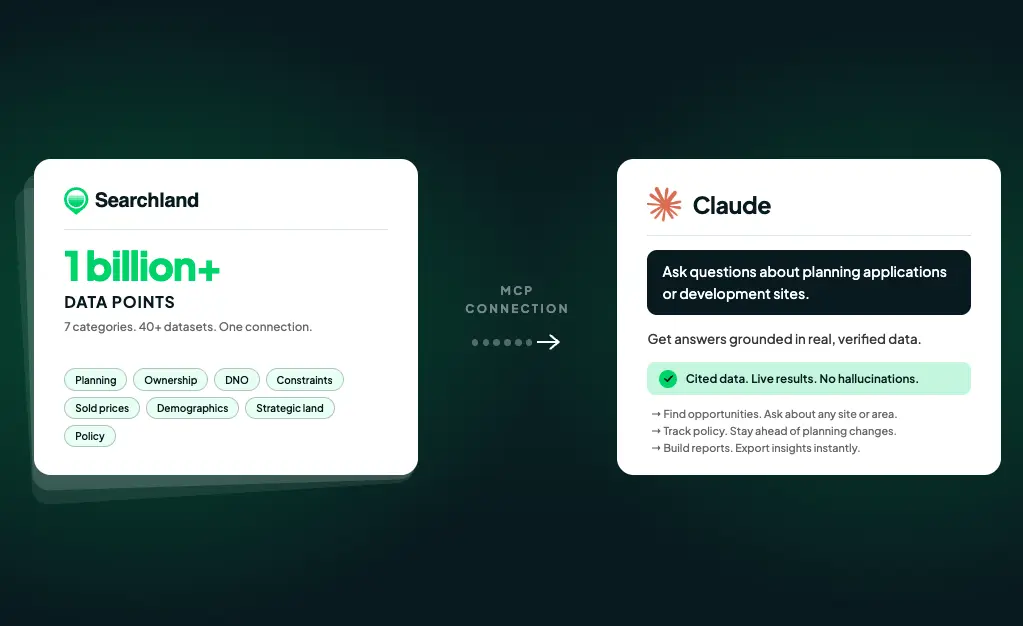
Searchland's MCP integration changes this. It connects your AI assistant - Claude, ChatGPT, or Microsoft Copilot - directly to live UK planning and land data, so when it answers a question, it's working from the same verified sources you'd pull from the dashboard yourself.
This post explains what that means, how it works, and why the teams getting this right now will be operating at a different speed to everyone else by the end of the year.
What MCP actually means
MCP stands for Model Context Protocol. You don't need to know what that means technically - but here's what it means in practice.
Until now, if you wanted your AI assistant to work with real data, you had to bring that data to it: copy from one tab, paste into another, prompt the AI, then go back and verify the output. MCP removes that step entirely. It's a connection that lets your AI assistant query a data platform directly, in real time, as part of the conversation.
Think of it as giving your AI assistant a direct line to Searchland, rather than relying on you to relay the information manually.
The dashboard isn't dead, but it's no longer the only interface
For years, every platform in the land and property data space, Searchland include, was built with the same goal: to become your team's single workspace. One dashboard, all your data layers, everything in one view.
This model still has real value. A well-built dashboard is still the best way to visualise overlapping constraints, run complex spatial searches, and compare sites side by side. Nothing can replace a well-designed visual layer when conducting a detailed site assessment.
But the reality is that your team's workflow now spans multiple tools. AI assistants like Claude and ChatGPT, spreadsheets, emails to agents, and internal appraisal templates. We've entered an era of multiple tools in our workflows, and the question isn't whether dashboards survive. They do. The question is whether your data can travel beyond the dashboard into the places your team needs it.
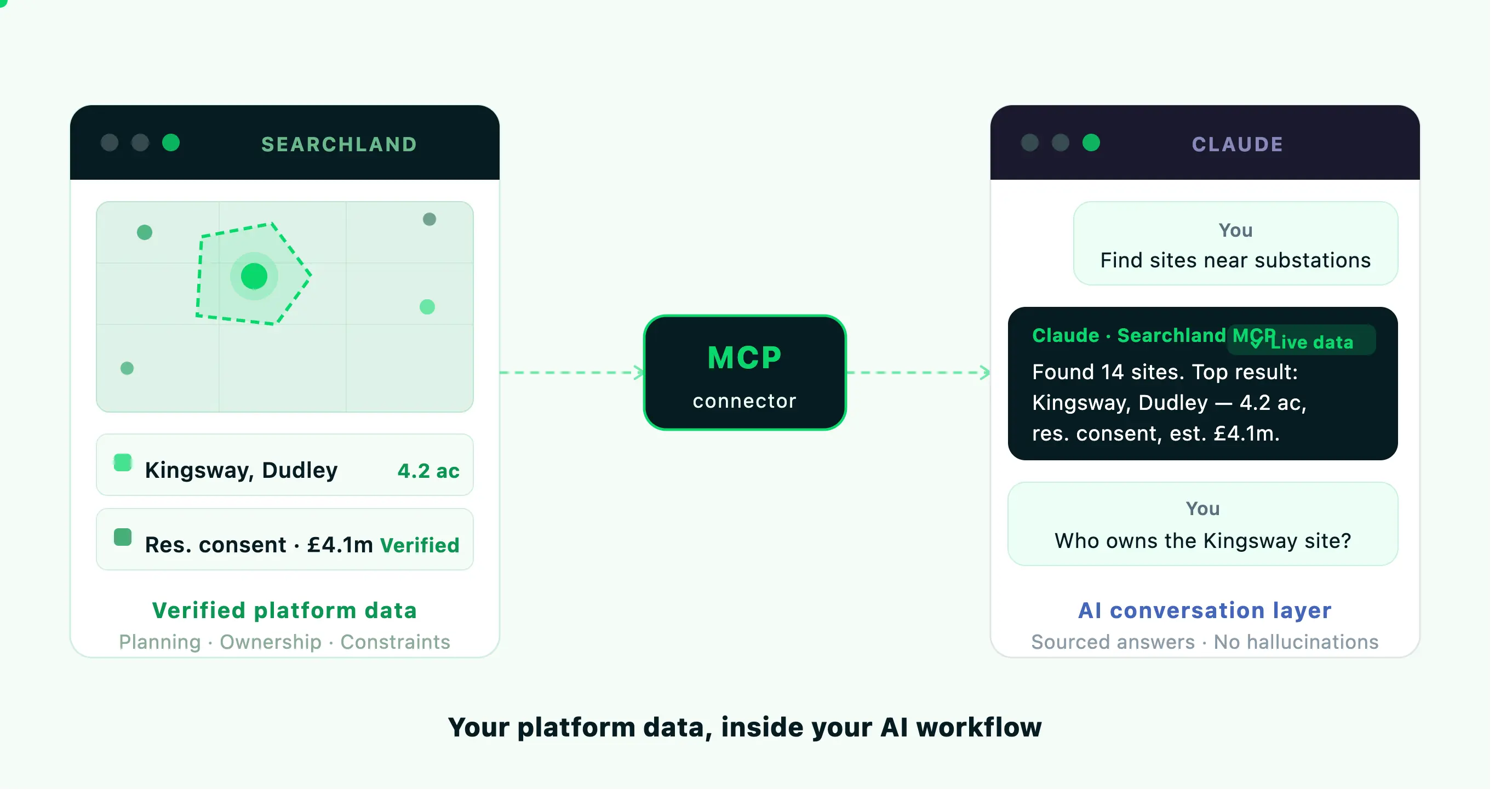
Diagram showing Searchland's platform data on the left — including a site map, planning consent, and land value — connected via an MCP connector to a Claude AI chat interface on the right, where a user asks questions and receives verified answers about specific sites.
AI is powerful, but it needs real, trustworthy data to have a real impact
Here's what AI does well: it orchestrates. It synthesises information from multiple sources, translates complex data into plain language, and drafts documents in seconds. For workflow and productivity, AI is genuinely transformative.
But here's what AI does badly - and you've definitely seen this for yourself: without proper data, AI just makes things up. Sometimes, without you even noticing.
For example, ask an AI assistant who owns a parcel of land, and it will give you a confident answer. Ask it about planning constraints on a specific site, and it will give you a comprehensive list. Ask it why a planning application was approved or refused, and it will tell you the reason with 100% certainty.
There have even been some high-profile cases of world-renowned consultants and law firms getting into hot water because of hallucinated AI responses. Planning is not exempt.
This isn't a criticism of AI. But it is the reality of large language models. They generate language, not verified facts. And in property development, unverified facts cost real money and waste time.
In 2026 and beyond, this is where specialist platforms like Searchland will earn their place. The division of labour is becoming clearer. AI handles the conversation layer: drafting, summarising, and synthesising. The land sourcing platform handles the judgment layer: the verified planning data, the ownership records, the site constraints, and everything else.
Up-to-date property data and site sourcing platforms are now more important than ever, not less.
Your data doesn't train anyone's AI
A reasonable concern when connecting any platform to an AI assistant is what happens to the data once it's been queried. The short answer: nothing you don't want to happen.
When you use Searchland's MCP integration, your AI assistant accesses Searchland datasets through a controlled connector. Your private project files, saved sites, and account data are not touched. And nothing you query is used to train any AI model - not Claude's, not ChatGPT's, not ours.
What you get is the same verified data you'd pull from the dashboard, delivered into your AI conversation. What you don't get is any additional exposure of your commercial intelligence.
It takes about five minutes to connect
MCP sounds technical. The setup isn't. You don't need a developer, and you don't need to write a line of code.
Connecting Searchland to your AI assistant is a single URL. Paste it into your AI tool's settings, and from that point on, any question that needs land data pulls it directly from Searchland. One connection, done once.
If you're already paying for a Searchland licence, the MCP connector is included. You can connect today.
Works with the AI tools your team already uses
Searchland's MCP integration works with Claude, ChatGPT, and Microsoft Copilot - the three AI assistants most commonly used by land and planning professionals in the UK today. More are being added as demand grows.
If your team runs on Microsoft 365, Copilot works. If individuals prefer Claude or ChatGPT for their own workflows, those work too. One Searchland connection covers all of them.
What this looks like in practice
If you're already using AI in your workflow, you'll recognise the friction. You find data in one platform, copy it, paste it into a prompt, ask the AI to do something with it, then cross-reference the output. It works, but it's clunky.
Now imagine your AI assistant could query the data directly. You ask it to find sites with residential consent within two miles of a substation, and it pulls a report based on live results from a verified database. You ask it to summarise the planning history for a specific parcel, and it reads the actual officer reports rather than guessing. Your workflow doesn't change. It just gets faster and more reliable.
If you're not yet using AI day to day, think of this as a new way into the data you already have access to. Ask a question in plain English, get an answer grounded in real property data. It's another interface to your platform, not a replacement for it.
What you can actually ask it
Here's what Searchland's MCP lets your AI assistant answer directly, with verified data behind every response:
- Planning history for a specific site or parcel - including application status, decision dates, and officer reports
- Ownership records - who owns a piece of land, what they paid, and when
- Planning constraints - green belt, flood zones, listed buildings, and other designations
- Live planning pipeline - active applications within any area or radius you specify
- Housing land supply and LPA performance data
- EPC ratings, building regulation history, and energy infrastructure layers
Ask in plain English. Get a sourced answer. No copy-pasting, no switching tabs, no guessing.
The teams moving fastest are moving now
MCP adoption in land and property is still early. That window won't stay open for long.
The professionals already using AI with live data connections are completing site assessments in hours that used to take days. Across a full deal cycle - sourcing, appraisal, planning review, client reporting - that compounds quickly. The teams that build this into their workflow now will set a new internal benchmark for speed. Everyone else will be catching up.
This isn't a prediction. It's already happening.
Ready to connect your AI assistant to live UK planning data?
If you're already on a Searchland licence, you can connect today - it takes about five minutes, and no developer is needed. The MCP connector is included with all paid plans.
If you're not yet a Searchland customer, book a demo with our team. We'll show you exactly what your AI assistant can do with live planning data behind it - from querying a specific site's ownership and constraints to pulling a full planning pipeline for any LPA in the country.
The data your AI needs to stop guessing is already here.
Explore our free trial - or if you're an existing customer, jump into Searchland and connect now.