


MCP is having a moment. If you work in property, planning, or land, you've seen the term crop up - and chances are, you've already started experimenting. That's a good sign. The standard is genuinely useful, and the connectors being built on top of it are getting more serious by the week.
But as they multiply, one question is worth asking: what does a good one actually look like for property work?
What does a good MCP connector actually do?
At their simplest, MCP connectors give an AI model access to a data source. Ask a question, get data back. Useful - but in property and land, returning raw records is rarely where the work ends.
The whole job involves combining multiple sources, running analysis across them, and producing something a client or colleague can actually use. A connector that hands you data and leaves the rest to you hasn't removed work from your process. It's just moved it.
That distinction matters more than it might first seem.
35 UK property datasets in a single MCP connector
Property decisions don't live in a single dataset. A site appraisal draws on planning history, title ownership, sold prices, land values, EPCs, infrastructure constraints, and demographics. A planning case pulls in appeal records, decision timing, local policy, public comment sentiment.
If your connector covers one category, you're stitching outputs together manually - and that friction compounds fast.
Searchland spans 35 datasets in a single connector: planning applications and appeals, Land Registry titles, sold prices, land values, VOA business rates, EPCs, energy and grid infrastructure, demographics, and company ownership. One connector, one context, no stitching.

Server-side analytics for UK planning and land data
There's a real difference between a connector that retrieves data and one that computes answers.
Retrieve-only means you still aggregate, average, filter, and interpret. At scale - analysing approval rates across a district, benchmarking land values across comparable sites - that's significant work. Searchland's analyse tool runs aggregations server-side: averages, medians, percentiles, breakdowns, time-series trends. You ask the question and get the answer. The model doesn't need to process hundreds of raw records to tell you the median decision time in a given LPA. It already knows.
And when the analysis is complete, the connector doesn't stop at insights - it prompts the next step, guiding you through the arguments to address, the data to gather, and the deliverable to produce.
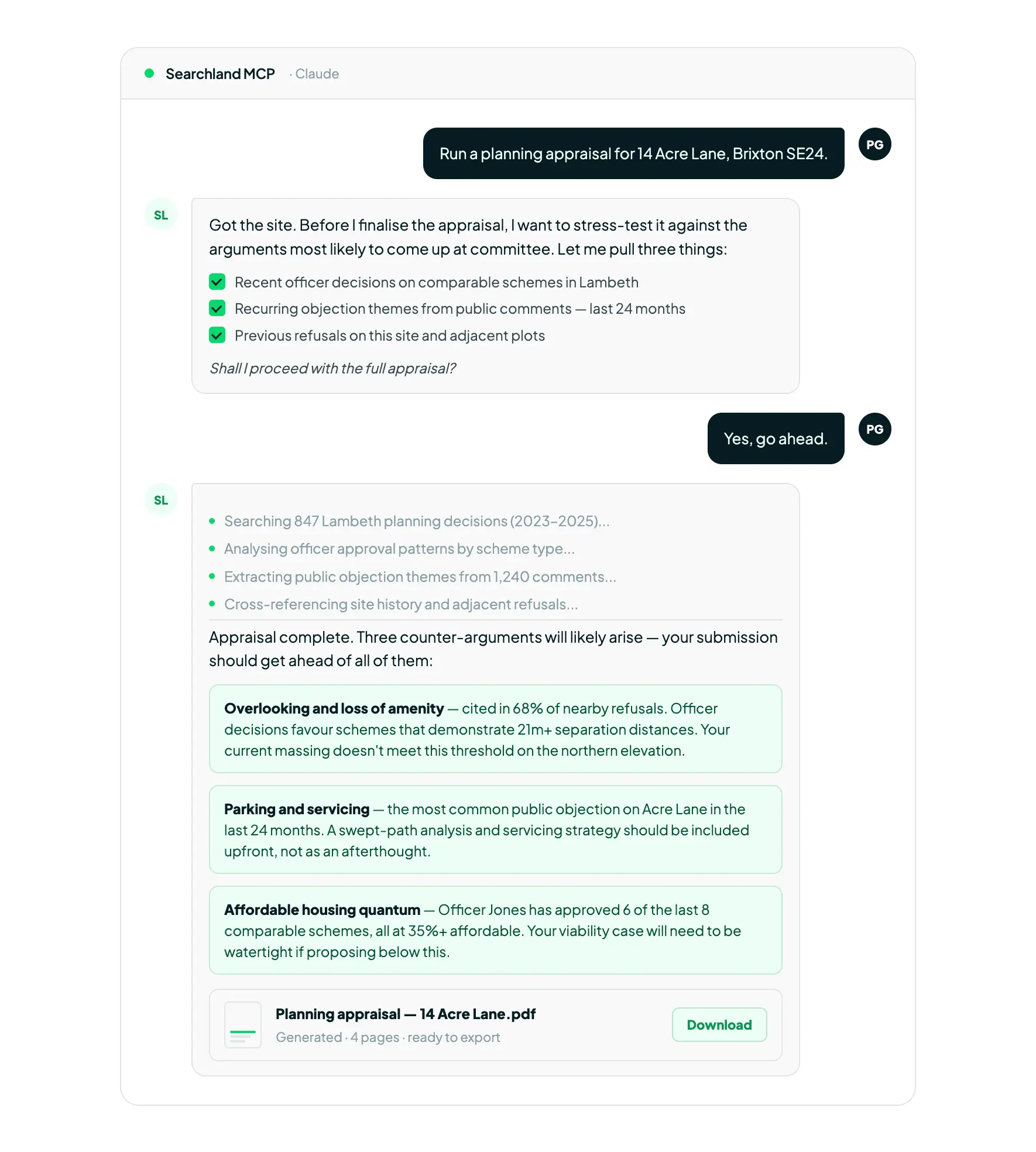
From data to deliverables: appraisals, planning statements and site reports
The connectors that will matter most aren't the ones that surface data - they're the ones that produce work.
Searchland includes guided playbooks for the outputs property professionals actually need: financial development appraisals, planning statements, and full site reports combining Land Registry title data with planning history, SHLAA allocations, and local plan context. They supply the methodology, pull the relevant data, and structure the output - exportable as Excel, PDF, or Word.
And because the connector works alongside Claude's broader capabilities, it's now possible to generate professional, interactive data dashboards on the fly - the kind of output that simply wasn't on the table even a few months ago. Client-ready, not draft-ready.
Title registers and plans, purchased without leaving the chat
Due diligence used to mean pausing your analysis to buy documents elsewhere. Not anymore. The Searchland MCP connector can now purchase official title registers and plans directly - individually or in bulk, across as many titles as you need to purchase. Ask for the registers and plans covering every title on a site, and the connector buys them and hands back a direct link to each document, right there in the conversation.
No portal, no separate login, no working through titles one at a time. Just the data you asked for, and now the paperwork to back it up.
Precision where it counts
Data breadth and analytics are only as useful as the underlying model is detailed. Searchland's datasets are richly modelled - 187 fields on titles, 160 on planning applications - with typed filters and flexible spatial scoping across point, polygon, or administrative area. The connector also includes Street View and satellite imagery with title boundaries overlaid, geocoding, and area lookup, so spatial queries are as precise as everything else.
UK planning data quality: how MCP connectors compare
Breadth and tooling only matter if the underlying data holds up. So we tested it.
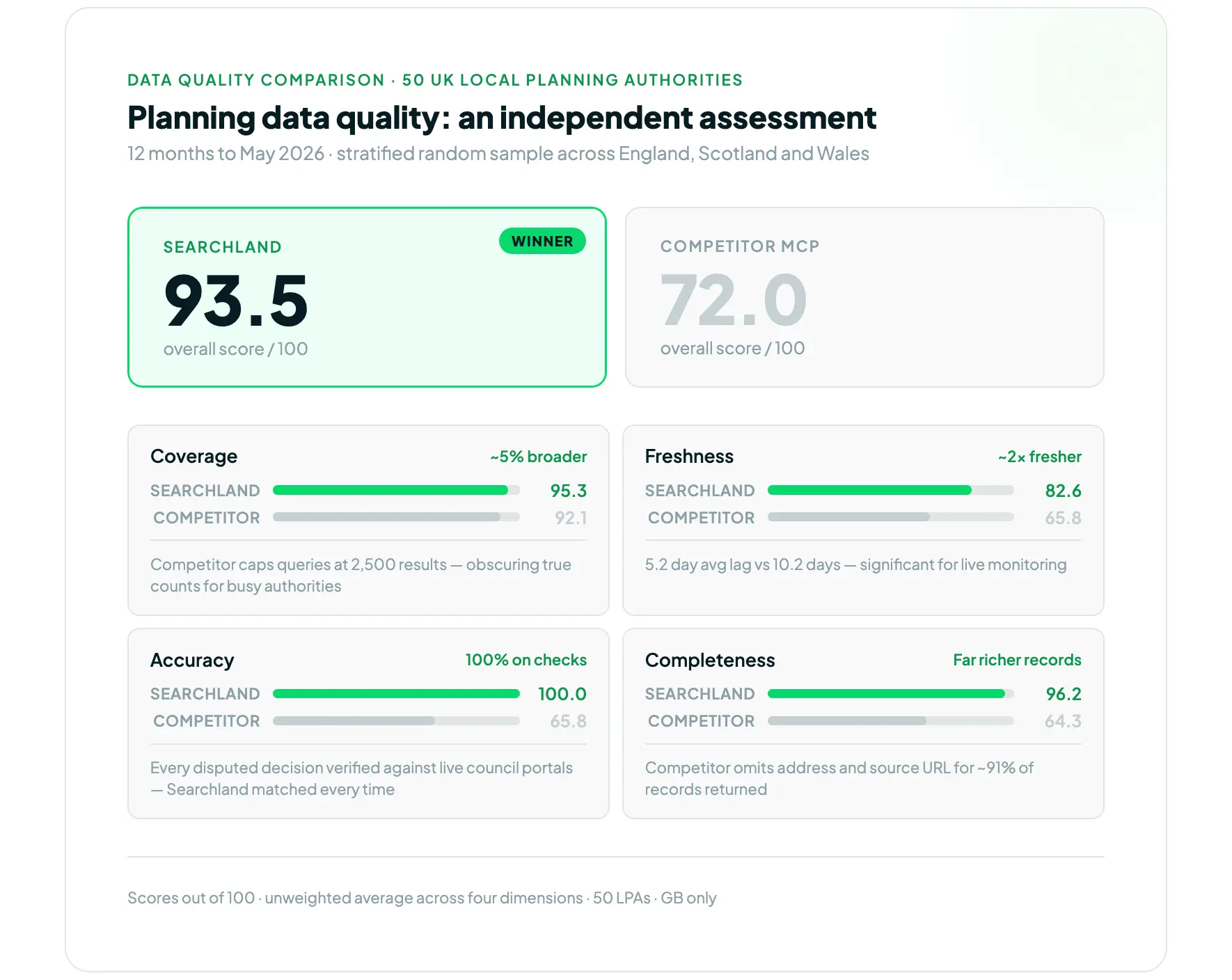
Across 50 UK local planning authorities, Searchland scored 93.5 out of 100 against a competing MCP connector's 72.0 - winning on every dimension: coverage, freshness, accuracy, and completeness. Searchland's planning data averaged 5.2 days old versus 10.2 for the alternative. When decision records were checked against live council portals, Searchland matched every time. And where the alternative omitted site addresses and source links for the majority of records returned, Searchland populated 96% of key fields across the board.
Clean, current, complete data isn't a bonus feature. It's the foundation everything else is built on.
Choosing the right MCP connector for property work
When evaluating any MCP connector for property work, the question isn't just whether it has the data you need. It's whether it reduces the work you have to do - or just changes where you do it.
A connector that retrieves records across one dataset moves work into your AI conversation. A connector that spans 35 datasets, computes analysis server-side, and produces client-ready deliverables removes work from the process entirely.
That's the difference Searchland is built around.
The Searchland MCP connector is live. Connect it and start querying live data in minutes, or check plans and MCP token allowances before you do.