

If you've spent any time in PropTech circles in the last six months, you'll have heard the acronym MCP - Model Context Protocol - appearing in product announcements, LinkedIn posts, and pitch decks. Most explanations of it are written for software engineers, which means most land professionals have, understandably, ignored them.
That's a mistake. MCP is the most significant shift in how land professionals will access data since the move from physical Land Registry searches to online portals. It's not hype, it's not a feature, and it's not specific to one company or AI tool. It's a new standard - and it's already changing how site assessments, planning appraisals, and land sourcing get done.
This guide explains what MCP is, why it matters for land sourcing, and what to do about it.
The short version
An MCP (Model Context Protocol) is a way of connecting an AI assistant - like Claude, ChatGPT, or Microsoft Copilot - directly to a specific dataset or tool, so you can ask questions in plain English and get structured, accurate answers back.
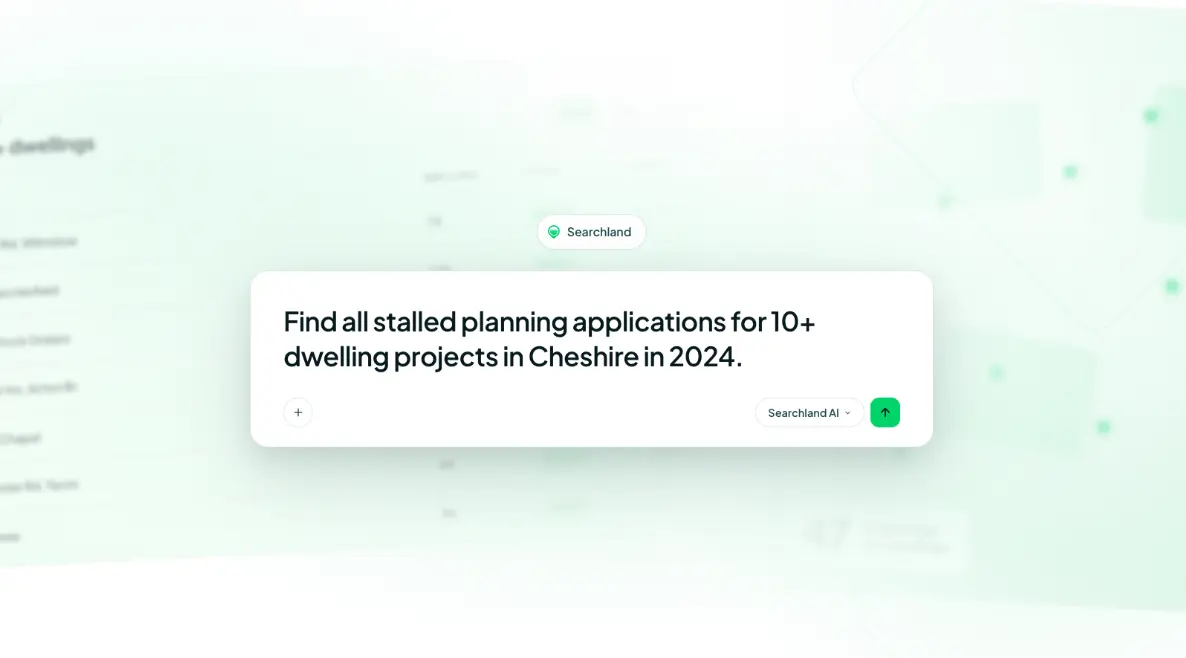
For land professionals, this means you can connect an AI assistant to a property data platform and ask things like "Find sites over 2 acres in Surrey with no live planning, owned by trading companies" - and get a real, cited answer in under a minute.
That's the headline. Everything else is detail.
What is an MCP?
The Model Context Protocol was introduced by Anthropic in late 2024 as an open standard for connecting AI assistants to external data and tools. It has since been adopted by every major AI provider - OpenAI, Google, Microsoft, Amazon - and now sits under the governance of the Linux Foundation.
The technical analogy that gets used is USB-C. Before USB-C, every device had its own connector. Phones, laptops, headphones, cameras - each needed a different cable. USB-C unified them. MCP does the same thing for AI: instead of each AI tool needing custom-built integrations to every data source, MCP provides one standard way for them to talk to each other.
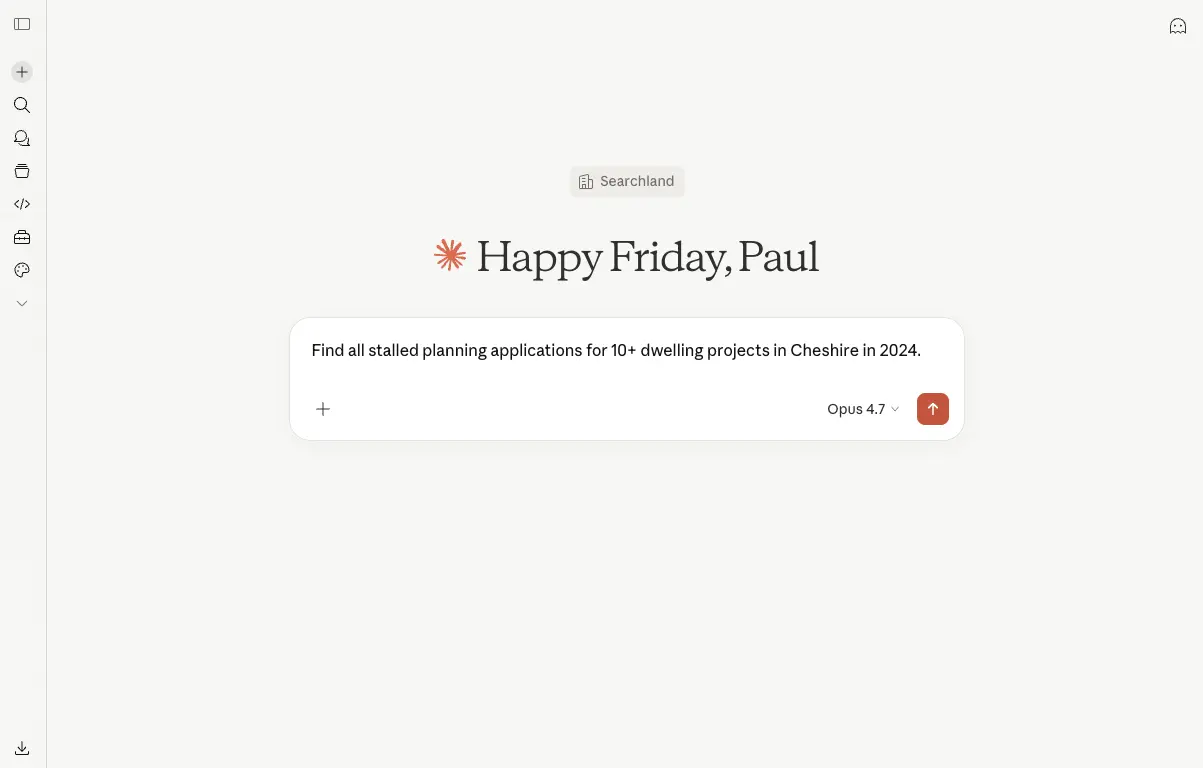
For the user, the practical result is simple: you connect an AI assistant to a data source once, and from then on, you can ask it questions in plain English.
You don't write code. You don't learn a query language. You don't memorise field names. You describe what you want, and the assistant handles the rest.
Why MCP's matter for land data
Land sourcing has always been a data problem dressed up as a judgement problem.
A typical site assessment involves stitching together information from HM Land Registry, the planning portal, Companies House, EPC data, flood maps, the Local Plan, comparable consents, ownership history, and any number of policy documents. A senior land director can sense-check a site in minutes - but only because they've spent fifteen years building the mental model. The data work underneath that judgement is slow, repetitive, and expensive.
What MCP changes is the data work, not the judgement. Specifically:
1. Natural language replaces query builders.The traditional way of pulling site data is to log into a platform, choose filters, run a search, export to CSV, and stitch the results together in a spreadsheet. With an MCP-connected AI assistant, you describe the site in a sentence and the assistant pulls the data, structures it, and writes the report. The platform is still doing the data work - but you're no longer the one operating it.
2. Cross-referencing happens automatically.A site assessment isn't one query, it's twenty. Title information from one source, planning history from another, ownership data from a third. An AI assistant connected via MCP can pull from all of them in a single prompt, cross-reference the results, and flag inconsistencies. What used to take half a day takes ninety seconds.
3. Reports become conversational.Traditional reports are static - you generate them, you read them, and if you have follow-up questions, you go back to the platform. With an MCP-connected assistant, a report is a starting point for a conversation. "Show me the planning history for the three sites with the highest GDV." "Which of these LPAs has the weakest five-year housing land supply?" The data is there; the questions can keep coming.
4. The audit trail is preserved.This is the part that matters most for serious land professionals. A good MCP implementation cites every figure back to its source. You can verify any claim in one click - far more auditable than a spreadsheet that's been touched by three analysts and a mail merge.
What an MCP is not
There's a lot of marketing noise around AI in property right now, and it's worth being precise about what MCP is and isn't.
It is not a chatbot. Chatbots are usually trained on a fixed dataset and answer from memory. An MCP-connected assistant queries live data every time you ask a question. The data it returns is current, real, and traceable.
It is not the same as ChatGPT searching the web. Web-search AI tools pull from public sources of varying quality. An MCP connected to a property data platform pulls from a curated, structured dataset - HM Land Registry, planning records, Companies House, and so on. The difference is the difference between a Google result and a Land Registry title.
It is not a replacement for the platform. The platform still does the data work - gathering, cleaning, indexing, and serving the data. MCP is the layer on top that lets you access that data through an AI assistant rather than a dashboard.
It is not tied to one AI assistant. Because MCP is an open standard, the same connection works across multiple assistants. A property data MCP that's live in Claude today will work in ChatGPT, Gemini, and Copilot as those tools roll out their MCP support.
What does MCP mean for land sourcing in practice?
Here are four concrete jobs an MCP-connected land data platform changes.
Site assessment
The traditional workflow: an analyst pulls title information, planning history, constraint overlays, flood data, and comparables, then writes a brief.
With MCP: the analyst asks the AI assistant for a brief on a specific address, including everything above. The assistant pulls from the connected data sources, structures the response, and cites every figure. The brief takes minutes, not hours. The analyst spends the saved time on the bits that need human judgement: viability, strategy, recommendation.
Opportunity sourcing
The traditional workflow: a land sourcer defines criteria in a platform - size, location, ownership, planning status - runs a search, and reviews results.
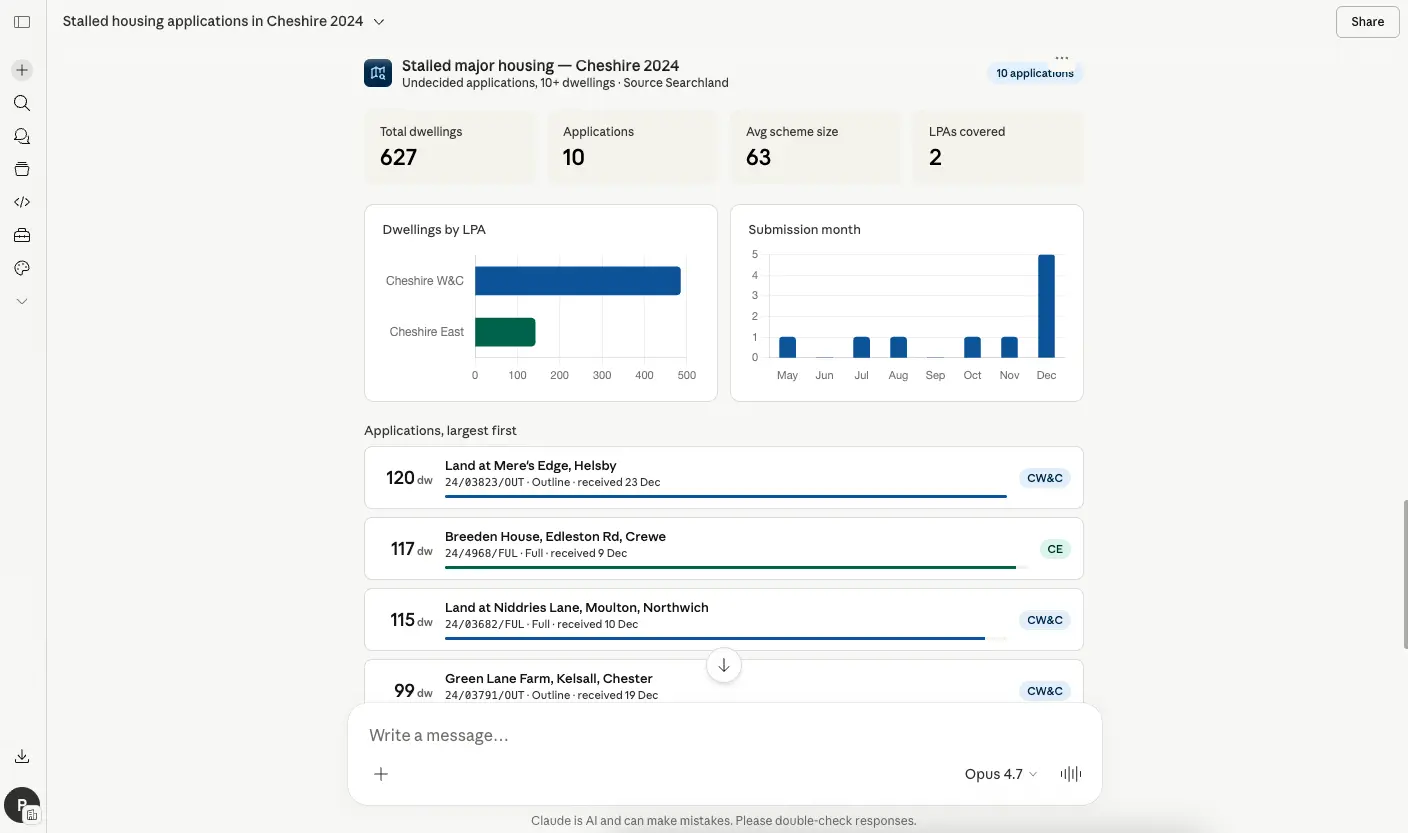
With MCP: the sourcer describes what they're looking for in a sentence. "Sites over 2 acres in Surrey, no live planning, owned by trading companies, within 10 minutes of a station." The assistant returns a ranked list, with reasoning for each. Refinement is conversational: "Now exclude anything in Green Belt." No filters, no field names.
Policy tracking
The traditional workflow: a planner monitors LPA performance - Housing Delivery Test scores, plan stage, five-year land supply - across multiple authorities. This means visiting multiple sources, exporting data, and building a tracker.
With MCP: the planner asks the assistant to rank LPAs in a region by HDT score, plan stage, and unallocated sites. The assistant pulls live data from each source and produces a comparison. Updates are a re-run, not a rebuild.
Strategic appraisals
The traditional workflow: a land team building a strategic appraisal - say, a one-pager on an LPA covering allocations, HDT, 5YLS, live applications, top owners, and active developers - assembles the data manually from seven or eight sources.
With MCP: the team asks the assistant for the one-pager. The assistant pulls each section, structures it, and cites every figure. The team reviews, edits, and signs off - instead of building from scratch.
Why land professionals should care about MCPs
A few reasons this isn't a "wait and see" technology.
MCP is now infrastructure, not experimentation. As of early 2026, more than 10,000 public MCP servers exist across registries, and every major AI provider supports the standard. SaaS platforms across categories - from project management to design tools - have shipped MCP servers. Property data is one of the last major B2B categories where the work is still being done in dashboards rather than via AI assistants. That's changing fast.
The competitive shift is already happening. Land professionals using MCP-connected data platforms are spending hours on what used to take days. The compounding effect over a deal cycle - faster site assessment, faster opportunity sourcing, faster appraisals - is significant. The teams that adopt early will set new internal benchmarks for how fast land work should move.
The cost of waiting is now a real cost. The early adopters won't just be faster. They'll be working with better cross-referenced data, better audit trails, and better strategic visibility - because the AI is doing the cross-referencing in real time, not relying on whatever the analyst remembered to check.
How to start
If you're a Searchland customer, you can already access an MCP connection - it's included with your licence. Connect once and start asking questions about UK land data in plain English. Reports come back structured, cited, and ready to share.
If you're not a Searchland customer yet, you can start a trial - we'll set you up with an MCP connection and walk you through what's possible on a real site you're working on.
Either way, the moment to start using MCP on land data is now. The infrastructure is here, the standard is settled, and the productivity gap between teams that use it and teams that don't is widening every week.
Frequently asked questions
Do I need to be technical to use MCP?
No. The setup is three steps: copy a connection URL, paste it into your AI assistant, sign in. The whole thing takes less than five minutes. Once it's connected, you ask questions in plain English.
Which AI assistants support MCP?
Every major one, in some form. Claude was first, with full support. ChatGPT, Gemini, and Microsoft Copilot have MCP support live or rolling out. Because MCP is an open standard, the same connection works across all of them - you don't pick a platform and get locked in.
Is my data private?
A well-designed MCP connection only exposes the data the user is authorised to see. Your AI assistant queries the data; it doesn't store it, train on it, or share it. Anything proprietary stays proprietary.
How accurate are the answers?
As accurate as the underlying data. The AI doesn't make figures up - it retrieves them from the connected sources. Good MCP implementations cite every figure back to source, so any claim can be verified in one click. The standard for trust here should be higher than for either traditional analyst work or general-purpose AI.
What's the difference between MCP and a normal API?
A traditional API needs developers to integrate with it - every connection between every tool and every AI requires custom code. MCP is a standard that any AI assistant can speak, so one connection works across all of them. For users, the practical difference is that MCP needs no code; you describe what you want in English, and the assistant handles the translation.
Searchland MCP is live now. Connect Claude, ChatGPT or Copilot to 200+ UK land data sources and ask anything - site assessments, planning history, ownership, policy. ChatGPT, Gemini and other MCP-compatible assistants coming soon.