

What happens after planning approval? Tracking site activity and stakeholder comments
Developers move fast when they have clarity. But planning doesn’t end at approval - and until now, understanding what happens next has been fragmented, manual, and slow.
We’ve just shipped a set of updates to the Planning tool that changes that.
You can now:
- See what stakeholders are saying about applications
- Track what’s actually happening on-site after approval
All in one place.
See stakeholder sentiment with Planning Comments
Understanding a scheme isn’t just about the application - it’s about the response around it.
You can now access two new layers of insight directly within the Planning tool:
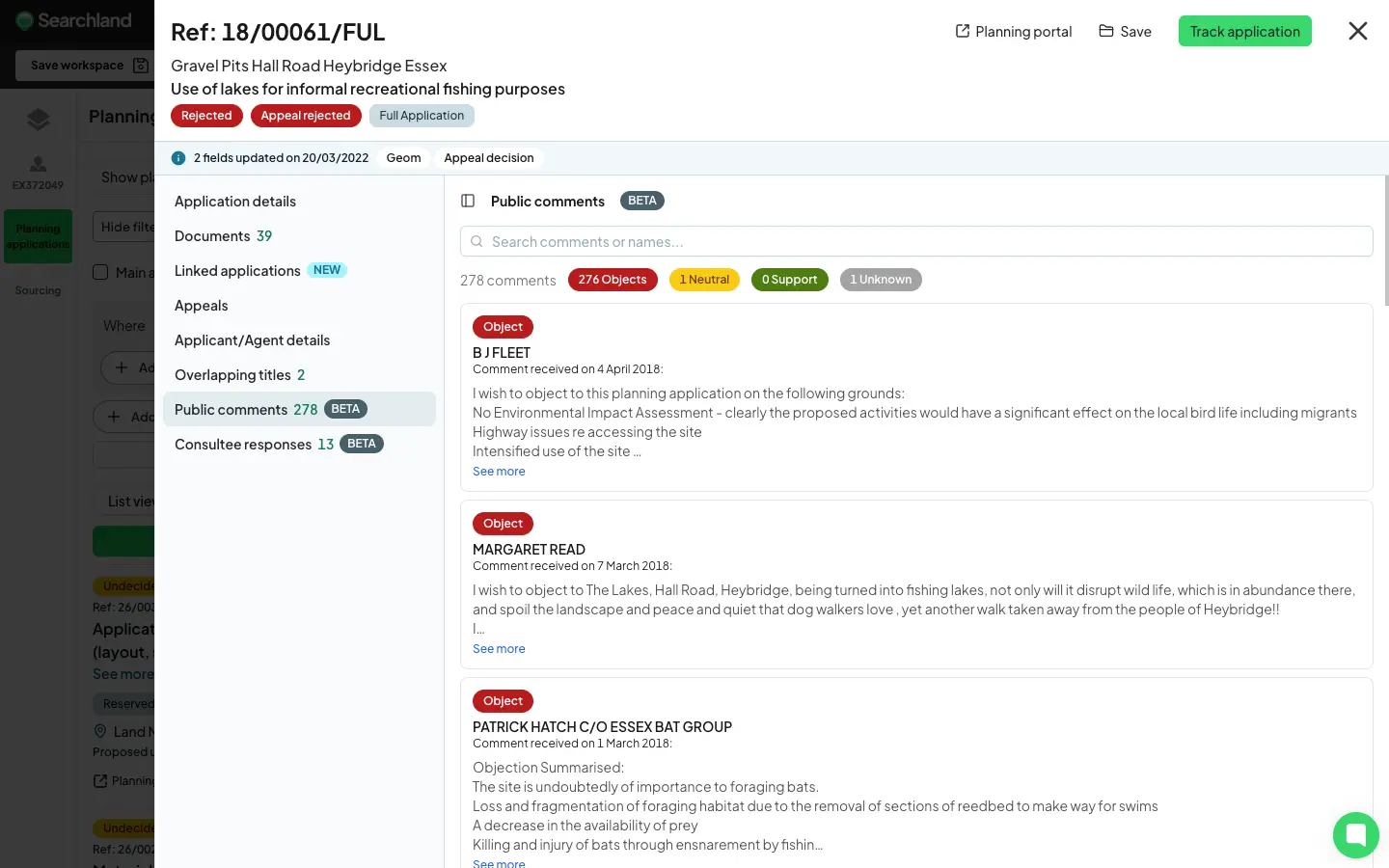
Public comments
View and search feedback from neighbours and the public - including objections, support and associated documents.
Consultee comments
See responses from statutory consultees and key stakeholders - from highways to environmental bodies - alongside consultation timelines.
Why this matters
Instead of manually digging through council portals, you can now:
- Identify applications facing heavy opposition
- Understand which stakeholders are influencing outcomes
- Surface key objections or support themes instantly
- Search for specific phrases or risks across comments
And because we extract text from uploaded documents - not just structured portal entries - you get broader coverage than standard planning tools.
Track what happens after approval with Site Activity
Approval doesn’t mean delivery.
So we built a way to track what actually happens next.
Introducing Site Activity
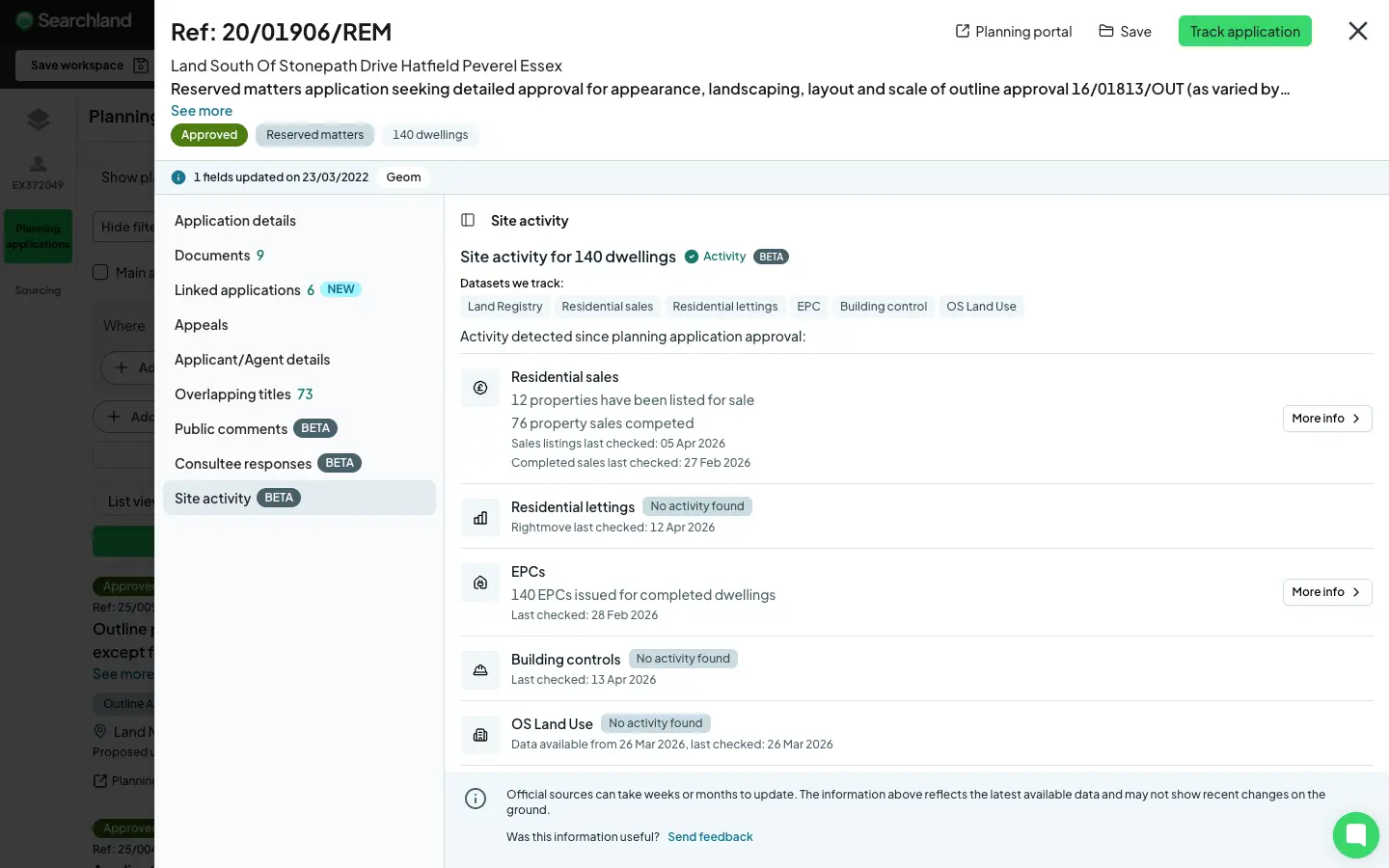
Site Activity gives you a live view of what’s happening on a site after planning approval - combining multiple datasets into one simple view.
From the planning card, you’ll now see:
- An “Activity” badge when movement has been detected
- A dedicated Site Activity panel showing progress over time
What we track
We monitor activity across six key datasets:
- Residential sales (Rightmove) - properties listed or sold
- Residential lettings (Rightmove) - properties marketed to let
- Land Registry - ownership and title changes
- EPC data - certificates issued for completed dwellings
- Building controls (Beta) - construction activity signals
- OS land use - classification changes (e.g. construction sites)
Each dataset shows:
- What’s been detected
- When it was last updated
- Whether activity has been found
Why this matters
This gives you a clear answer to questions that are usually hard to track:
- Has construction actually started?
- Is the scheme stalled?
- Are units being sold or let?
- Has the site changed hands?
Whether you’re sourcing new opportunities or monitoring your pipeline, you now have real-world signals - not just planning status.
Built for how teams actually work
- Land & new homes agents can see instantly whether a site is progressing or already selling
- Developers can track their own sites and monitor competing schemes
- Energy & utilities can identify active development sites for infrastructure planning
- Land promoters can understand whether sites are being built out
From planning insight → real-world intelligence
Taken together, these updates give you something new: a connected view of planning, from application and stakeholder sentiment through to approval and delivery. Instead of jumping between council portals, PDFs, Land Registry records and property listings, you can now understand the full picture in one place.
What this unlocks
This means you can find opportunities earlier and with more confidence, avoid schemes with hidden risk or resistance, and track whether sites are actually progressing. Most importantly, it gives you a clearer understanding of real-world outcomes - not just planning decisions.
Ready to explore?
These features are live in the Planning tool now.
If you’re already using Searchland, head into the platform and start exploring Site Activity and Planning Comments.
Read more about Planning Comments and Site Activity on the Planning Applications feature page. This is a Standard feature - see how it fits into your plan on pricing, or book a demo to see it in action.