


By Jack Brown, Marketing Director, BlockLand - The Apartment Block Agents
In many cases, the opportunity starts by identifying the right freehold title and contacting the owner directly, often before the property has been formally put up for sale.
At BlockLand, we specialise in apartment blocks. An important part of our sourcing process is identifying an unsplit multi unit freehold block where value may still be created through active asset management, refurbishment, rental improvement or title splitting.
The challenge is finding these opportunities at scale without wasting time and money researching unsuitable properties.
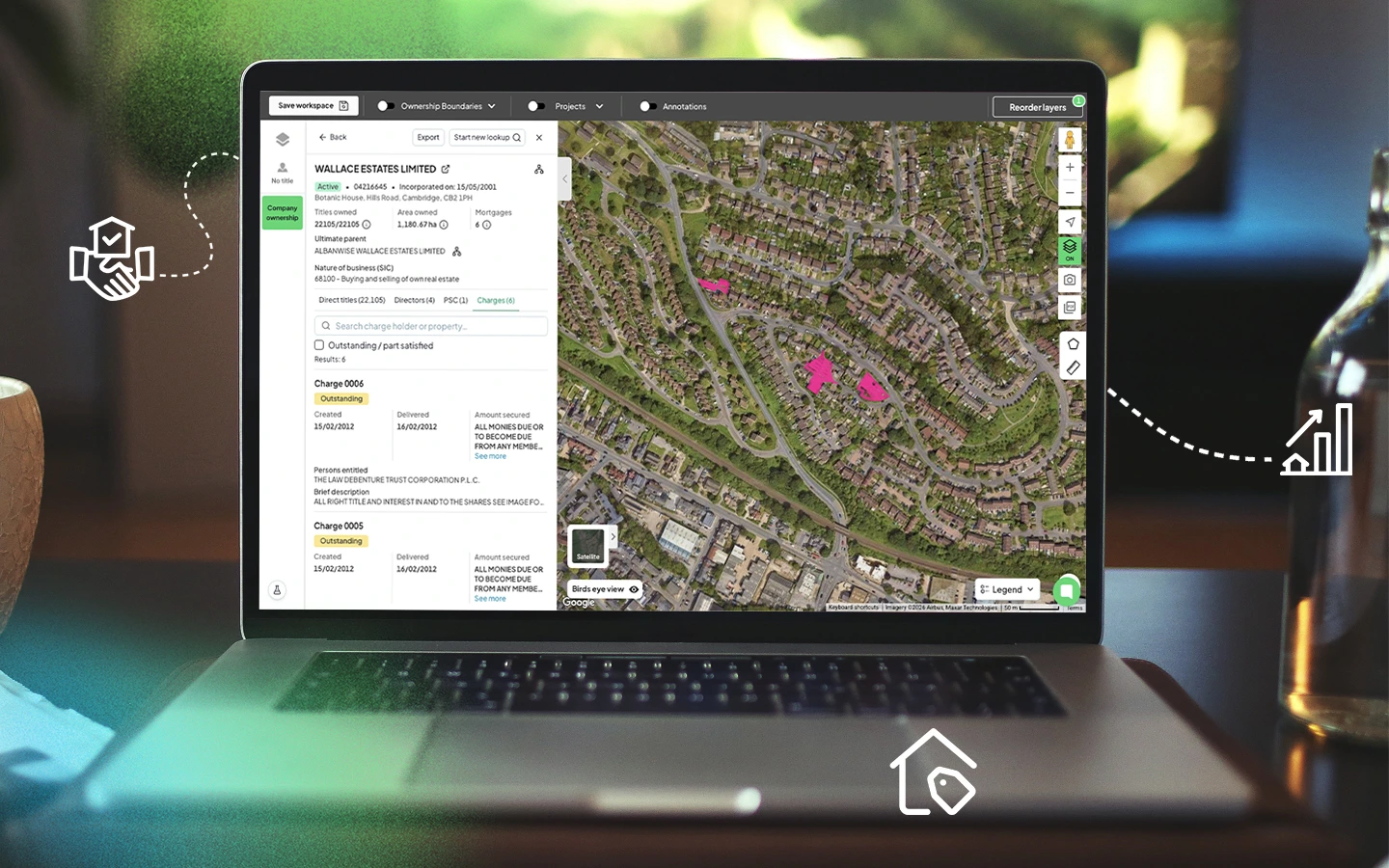
Searchland has become one of the most valuable tools in our entire sourcing process. Its property ownership and sourcing data allows us to combine several highly specific criteria into a single search, producing a focused list of potential apartment blocks in seconds.
Without the platform, this would involve individually reviewing thousands of unrelated titles, ownership records, leasehold interests, addresses and EPC certificates. That work could take countless hours to complete manually. Searchland allows us to carry it out in seconds.
What is a multi unit freehold block?
A multi unit freehold block, commonly shortened to MUFB, is a property containing multiple self-contained units held under a single freehold title.
It might be:
- A purpose-built apartment block
- A large house converted into flats
- Several properties held under one freehold title
- A mixed-use building containing commercial and residential units
- A small terrace or courtyard operating as one investment asset
Although the units sit within the same freehold ownership, each apartment may have its own tenancy, postal address, council tax account, utility supply and EPC.
From a lending and valuation perspective, the block is normally treated as an investment asset. Its value is influenced by factors such as rental income, investment yield, condition, tenancy profile, management requirements and the marketability of the block to another investor.
A multi unit freehold block is a collection of self-contained properties held under one freehold title and generally valued as a single income-producing investment.
We focus on this sector because apartment blocks provide more potential routes to create value than many conventional single-unit investments.
Alongside refurbishment and rental growth, an investor may be able to improve management, resolve compliance issues, restructure utilities, reconfigure underused space or create individual leasehold titles.
However, the availability of these strategies depends heavily on how the block is currently structured.
Unbroken vs broken blocks: Why the intact freehold matters
One of the first things we establish is whether a block is unbroken or broken.
An unbroken block is generally held under one freehold title, with no individual long leasehold titles already granted over the flats.
A broken or previously split block has one or more flats held on separate leasehold titles. Some units may already have been sold to individual owners, while the freeholder retains the remaining flats and the building’s freehold interest.
This distinction matters because much of the potential title-splitting uplift may already have been extracted from a broken block.
Why an intact freehold can be valuable
An unsplit multi unit freehold block is normally sold to another investor.
The buyer is purchasing an income-producing asset and will usually assess its value using the rent, operating costs, building condition and an appropriate investment yield.
Once suitable individual leasehold titles have been created, the market for the flats becomes much wider.
Depending on the building, location, lease structure and mortgageability of the units, the individual flats can potentially be sold to:
- First-time buyers
- Owner-occupiers
- Buy-to-let landlords
An owner-occupier may place a different value on an individual flat than an investor purchasing an entire block based on its rental return.
This difference between the investment value of the complete block and the combined value of the individual units is one of the reasons title splitting can create an opportunity.
Splitting titles is not automatically profitable and it does not suit every building. Legal structure, finance, planning, fire safety, utilities, unit sizes and saleability must all be investigated.
Nevertheless, an intact freehold gives the buyer more strategic options than a building where the individual titles have already been created and the resulting value has been realised by a previous owner.
Why waiting for listings is not enough
Property portals can still produce opportunities, but relying entirely on listed stock creates two problems.
The first is competition. By the time a strong multi unit freehold block reaches the open market, it may already have been reviewed by dozens of investors.
The second is valuation.
Apartment blocks do not always fit neatly into the valuation approach used for ordinary houses or individual flats. A generalist agent may compare the block with individual residential sales and multiply an estimated flat value by the number of units.
That approach can overlook the fact that an unsplit block is normally being sold as one investment asset to a more limited buyer market.
A proper appraisal may need to consider:
- Current and achievable rental income
- Local investment yields
- Occupancy and arrears
- Tenancy quality
- Building condition
- Fire and regulatory compliance
- Management intensity
- Capital expenditure
- The value and mortgageability of the individual units
When these factors are not fully understood, a block can enter the market with an asking price that is disconnected from its investment value.
It may then remain listed for months while the owner receives enquiries but no proceedable offers.
Direct-to-vendor sourcing creates a different kind of conversation. Instead of waiting for an owner to instruct an agent, we can identify a suitable property and contact the owner before a formal sales process begins.
How we use Searchland to find apartment blocks
Searching manually for every potential multi unit freehold block would be extremely time-consuming.
The real power of Searchland lies in its extensive logic filters. Rather than searching by one basic characteristic, we can combine ownership, tenure, address, leasehold and EPC data to produce a highly targeted list.
Our criteria vary between campaigns, but one of our typical searches includes the following filters.
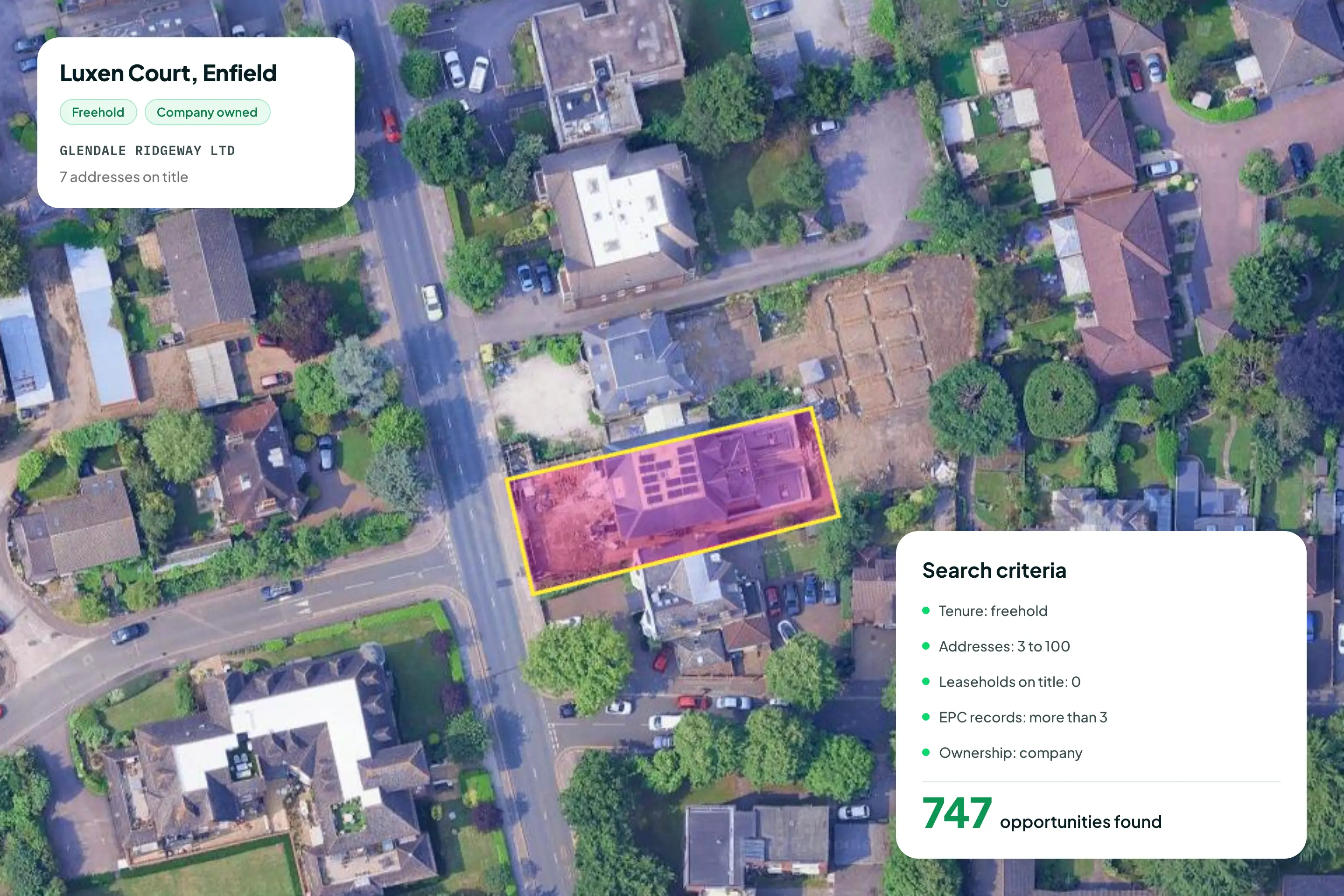
1. Freehold tenure
We begin by searching for freehold titles.
The objective is to identify the ownership of the complete building or site, rather than an individual leasehold flat within it.
2. Mixed-use titles
We frequently include mixed-use freehold titles.
Mixed-use titles can indicate buildings containing both residential and commercial accommodation, such as flats above shops. They can also reveal larger buildings where the title classification does not immediately identify the full residential use.
3. Multiple registered addresses
We search for freehold titles with between three and 50 addresses registered against them.
Multiple associated addresses can suggest that the freehold contains several flats, houses or commercial units.
This allows us to focus the search on titles that are more likely to contain a multi-unit property, rather than reviewing ordinary single dwellings.
4. No associated leasehold titles
Where our strategy depends on finding an unsplit block, we filter for freehold titles with no leasehold titles associated with them.
This helps distinguish a potentially intact multi unit freehold block from a building that has already been split into individual leasehold units.
It removes many unsuitable properties from the campaign before any further work or expenditure is required.
5. Company ownership
We often prioritise company-owned titles during the initial campaign.
Searchland provides company ownership information within the platform, which allows us to identify the entity behind the property and, in some cases, research its wider portfolio.
This data is available without purchasing an individual Land Registry title.
For privately owned property, identifying the registered proprietor generally requires purchasing the title register. At the time of writing, HM Land Registry charges £7 for a digital copy of a title register.
Prioritising company-owned titles therefore allows us to create and test a substantial campaign while keeping the initial data cost low.
6. EPC floor area
EPC information can provide an early indication of the size and number of units within a building.
This is particularly important when assessing title-splitting opportunities.
Very small studio flats can reduce the number of lenders willing to finance the individual units. They may also appeal to a smaller resale market and make the refinance or sale strategy more difficult.
Where appropriate, we use the floor area recorded on EPC certificates to avoid buildings dominated by unusually small studio apartments.
7. Geographic and commercial criteria
The property still needs to work as an investment.
Depending on the campaign, we may also consider:
- Local rental demand
- Achievable yields
- Individual flat sale values
- Employment and transport links
- Local licensing requirements
- Demand from owner-occupiers
- The age and type of housing stock
Searchland allows these different criteria to be brought together in one targeted search rather than being researched through several disconnected systems.
What a good multi unit freehold block looks like on paper
A good candidate may have:
- One intact freehold title
- Several associated residential addresses
- No associated long leasehold titles
- Self-contained accommodation
- Verifiable planning approval for the accommodation in place
- Sensible unit sizes
- Evidence of individual EPC certificates
- A company or clearly identifiable registered owner
- Strong local rental demand
- Individual flat values that may exceed the block’s investment value
- Potential for rental, management or condition improvements
- A realistic route to refinance or sell the individual units
No single point proves that the property will make a successful deal. The purpose of the search is to identify titles that match enough of these characteristics to justify contacting the owner.
Turning Searchland data into a direct-to-vendor campaign
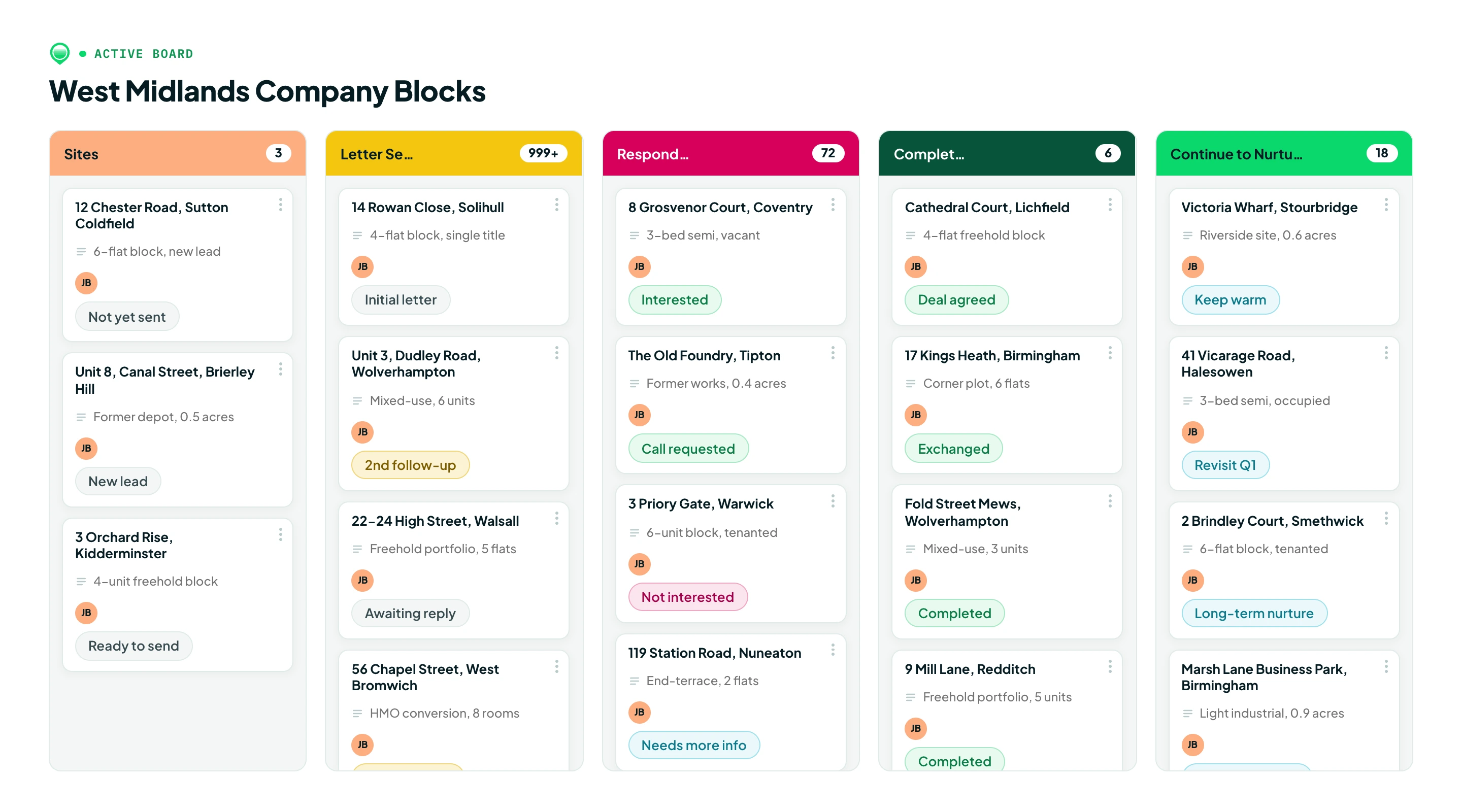
Once the logic filters have produced a targeted list, we categorise the properties based on factors such as location, building type, number of addresses and campaign priority.
We can then use Searchland’s built-in letter-sending tools to design and run a structured direct-to-vendor campaign.
This is not normally a case of sending one letter and waiting for deals to arrive.
Owners may be interested in selling but not respond to the first letter. They may put it aside, forget about it or decide that the timing is not right.
For this reason, we typically structure a multi-stage campaign with follow-up letters sent over six to 12 months.
The campaign may include:
- An initial introduction
- A follow-up explaining our specialism in apartment blocks
- A reminder several months later
- A final follow-up asking whether the owner’s plans have changed
Consistency is important. A property owner who has no interest in selling today may be considering it six months later because of refinancing, retirement, management problems, partnership changes or a shift in personal circumstances.
Responses should then be recorded in a CRM. A well-organised spreadsheet can also do the job.
The important information to track includes:
- The property address
- Ownership details
- The date each letter was sent
- Whether the owner responded
- The owner’s current position
- Their likely motivation
- Any price expectations
- The agreed follow-up date
- Notes from previous conversations
Searchland makes it possible to move from a very specific search to a repeatable, long-term owner-contact campaign without manually reviewing thousands of unrelated properties.
What can kill a multi unit freehold block deal?
It is tempting to create a fixed list of problems that automatically make a block unsuitable.
In practice, most issues can be investigated, priced into the offer, remedied or reflected in the transaction structure.
More often than not, the problem itself does not kill the transaction. Poor communication does.
When an issue arises, the buyer, seller, solicitor, broker, lender and valuer need to understand:
- What the problem is
- Who is responsible for resolving it
- What it is likely to cost
- How long it may take
- Whether it affects the proposed exit
- How it will be dealt with before or after completion
Several areas still require particular attention.
Unit sizes
Unit size matters when the exit strategy involves refinancing or selling the flats separately.
Small studio apartments may be acceptable to one lender but unacceptable to another. Even where finance is available, a restricted lender pool can affect valuation, mortgageability and saleability.
The floor area of each unit should therefore be considered before committing to a title-splitting strategy.
Separated utilities
Individually metered electricity, gas and water can make a block easier to manage, refinance and sell.
Where supplies are shared, the cost of separating them can be substantial. It may require:
- New meters
- Upgraded incoming supplies
- New pipework or cabling
- Access agreements
- Alterations to communal areas
- Work inside occupied flats
These costs are easy to overlook during an initial appraisal but can materially affect the required capital and final return.
Planning and lawful use
The accommodation in place should have the correct planning status.
A building may physically contain several flats without having clear planning approval or evidence of lawful use for each unit.
Planning history, building regulations information and any relevant lawful development certificates should be reviewed as part of the due-diligence process.
A lack of clear planning evidence can affect lending, valuation, insurance and the ability to sell or refinance the units separately.
EWS1 and external wall information
EWS1 is most commonly associated with larger or taller residential buildings where the external wall system, cladding or balcony materials may affect mortgage valuation.
However, EWS1 requirements are not determined by height alone.
The construction materials, type of cladding, extent of the external wall system, balconies, professional judgement and the requirements of the proposed lender can all be relevant.
Lower-rise blocks can therefore still be affected in certain circumstances.
An EWS1 form is an external-wall valuation document rather than a general building-safety certificate. It should be investigated where the building’s height, construction or external materials suggest it may be relevant.
The finance and exit strategy
The finance strategy should be considered before the acquisition completes.
Will the block remain under one multi-unit or commercial loan?
Will each flat be refinanced onto a separate buy-to-let mortgage?
Will some units be sold to recover capital while the remaining flats are retained?
The lender funding the acquisition should understand the proposed title-splitting and refinance strategy from the outset.
If the purchase lender is unaware that titles will be created or units released, concerns can arise later when the investor attempts to refinance or sell the individual flats.
Every deal should therefore be assessed with the intended exit in mind.
What direct-to-vendor sourcing has taught us
Searchland’s sourcing tool has been enormously valuable to BlockLand.
It has enabled us to turn a search that would otherwise require countless hours of manual title research into a quick, targeted and repeatable process.
We have sold hundreds of millions of pounds’ worth of apartment blocks sourced using Searchland’s tools. Its ability to identify the right ownership profiles at scale has been central to building a consistent pipeline of off-market block opportunities.
The biggest lesson is that direct-to-vendor sourcing is a numbers game.
Sending five letters and expecting to uncover the deal of a lifetime is not a strategy. Successful campaigns require consistency, suitable volume and structured follow-up.
The response is also only the beginning of the process.
When an owner replies, the deal has not simply fallen into your lap. The reply is the beginning of the work required to understand and construct the opportunity.
You still need to establish:
- Why the owner is considering selling
- What is motivating the potential sale
- How quickly they want to move
- Whether the price expectation is realistic
- Whether they value speed, certainty or flexibility
- What condition the building is in
- Whether accurate rental information is available
- Whether the property sits within an SPV
- Whether a property purchase or SPV purchase should be explored
- What issues need to be resolved before completion
It is equally important to recognise when an owner is not ready to sell.
This does not necessarily make the contact a bad lead. It simply means that it is not an active opportunity right now.
The details should be saved in a CRM or spreadsheet, including the owner’s position, previous conversations, likely timing and the date of the next follow-up.
Knowing when to move on is important. Continuing to negotiate with an owner who has no genuine motivation to sell can consume time that would be better spent speaking with the next potential vendor.
A vendor response is not the finished deal. It is an opportunity to understand the seller’s situation and begin constructing terms that work for both parties.
Why fast deal analysis matters
Once an owner responds, speed becomes important.
A vendor who replies to one direct letter may also be speaking with other investors, agents or buyers. Taking several weeks to decide whether the opportunity works can cause the conversation to lose momentum.
This is why we use a structured investment model when reviewing a potential multi unit freehold block.
The model should allow the investor to test:
- Purchase price
- Existing rental income
- Achievable rental income
- Refurbishment costs
- Professional and legal fees
- Title-splitting costs
- Finance costs
- Individual unit values
- Block investment value
- Deposit and capital required
- Refinance proceeds
- Units retained or sold
- Return on investment
- Internal rate of return
- Sensitivity to lower values or higher costs
We have developed a Title Splitting Deal Analyser to make this process quicker and more consistent.
The analyser allows an investor to enter the key deal information, compare different finance and exit routes and understand the likely capital requirement, return on investment and internal rate of return.
This is particularly useful when an owner has responded to a direct approach and an initial offer needs to be prepared quickly.
The tool does not replace legal, lending, tax or valuation advice. It helps investors determine which opportunities justify further investigation and professional due diligence.
Frequently asked questions
What does MUFB stand for?
MUFB stands for Multi-Unit Freehold Block - a property containing multiple self-contained units held under a single freehold title.
Common examples: a purpose-built apartment block, a large house converted into flats, several properties sitting under one freehold title, or a mixed-use building with commercial units below and flats above.
The key distinction is the single title. Each unit may have its own tenancy, postal address, council tax account, utility supply and EPC - but there's one freehold covering the lot, and the block is normally valued and lent against as a single income-producing investment rather than as a set of individual flats.
What is the difference between a multi unit freehold block and individual leasehold flats?
A multi unit freehold block contains several units held under one freehold title.
Individually split flats have their own leasehold titles, allowing them to be sold or financed separately, subject to the lease terms, property condition and lender requirements.
Is an unsplit block always more valuable?
Not automatically.
An unsplit block may provide more opportunities to create value, but the success of the strategy depends on the purchase price, rental performance, individual unit values, legal structure, planning status, building condition and the cost of creating separate titles.
How do you find the owner of an off-market apartment block?
Property ownership and title data can be used to identify the relevant freehold.
Searchland can help identify company-owned freehold titles and the entity behind them. For privately owned property, an official HM Land Registry title register will normally be required.
How many letters should you send?
There is no universal number.
The key is to create a targeted list, contact owners consistently and follow up over time. A campaign should be large enough to produce meaningful results without sacrificing the quality of the properties being targeted.
One letter is not always enough. A multi-stage campaign running over six to 12 months is more likely to reach an owner when their circumstances or plans change.
What information should a title-splitting deal analyser include?
A useful title-splitting model should calculate the capital required, purchase and refurbishment costs, finance costs, individual unit values, refinance proceeds, units sold or retained, return on investment and internal rate of return.
It should also allow different funding and exit strategies to be compared.
Final thoughts
Finding an off-market multi unit freehold block is not about discovering one secret filter.
It requires accurate property data, carefully constructed search logic, consistent owner outreach and the ability to analyse an opportunity quickly when a response arrives.
Searchland enables us to identify freehold titles with the ownership, address, leasehold and EPC characteristics associated with apartment blocks. More importantly, it turns a process that could take countless hours of manual research into a targeted search that can be completed in seconds.
The strongest opportunities are rarely delivered as finished deals. They are created by identifying the right property, starting the right conversation and understanding the numbers before committing significant time or capital.
Jack Brown
Marketing Director
BlockLand | The Apartment Block Agents
This article is for general information only and does not constitute legal, tax, valuation, lending or investment advice.