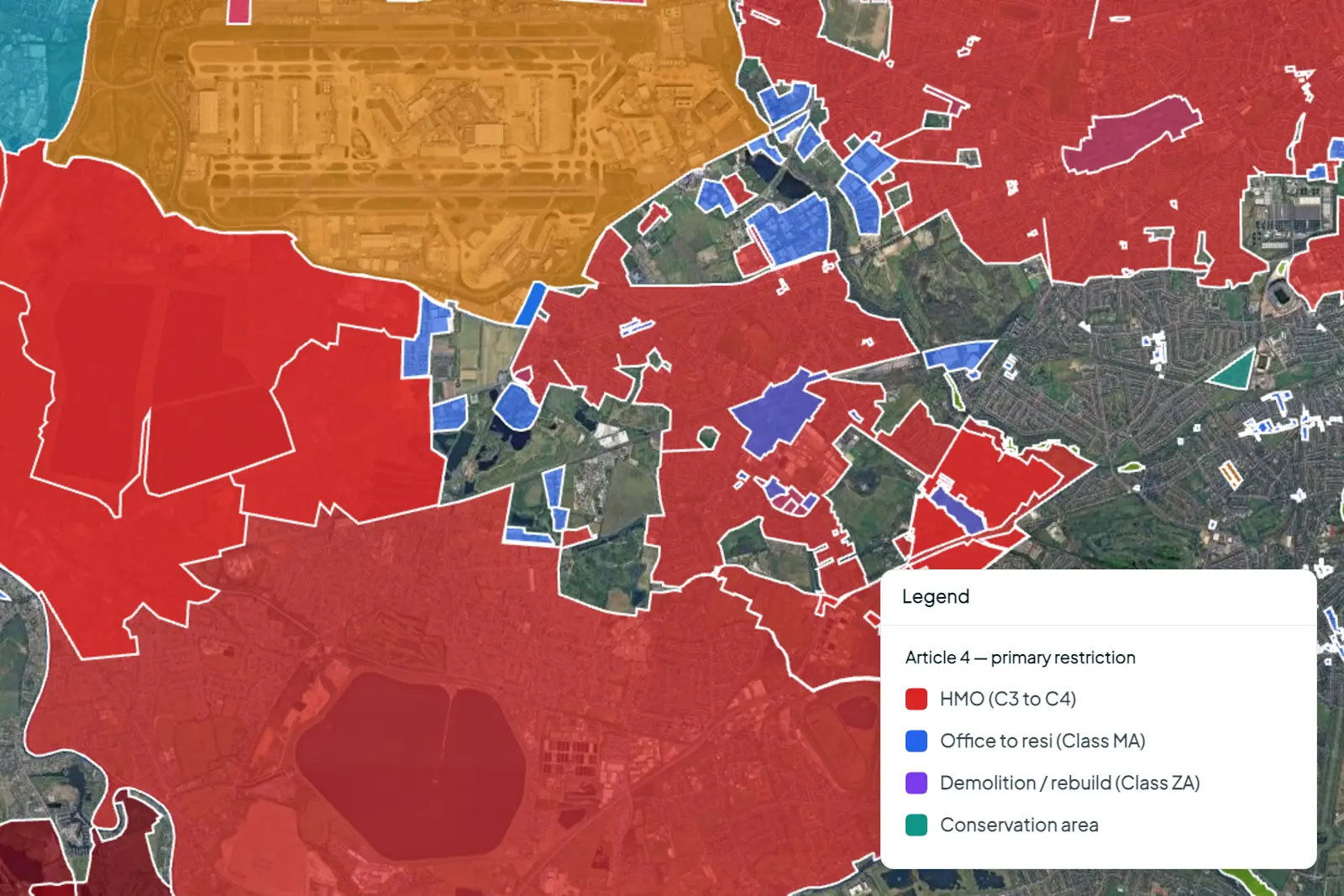


A site can look straightforward on paper. Right use class, right location, no obvious constraints. Then someone finds out, often too late, that the permitted development rights the scheme was relying on have been withdrawn by the council.
That's what an Article 4 Direction does. It removes specific permitted development (PD) rights that would otherwise apply automatically under the General Permitted Development Order (GPDO) 2015. Works that would normally go ahead without a planning application, such as a change of use, an extension, or a conversion, now need one instead.
It doesn't stop development. It just removes the automatic yes and hands the decision back to the local planning authority, application by application. For a developer, a planning consultant, or anyone assessing a site, that difference changes the cost, the timeline, and sometimes the entire viability of a scheme.
Searchland has re-enriched and re-released its Article 4 Direction data, with clearer search, in-platform document access, and full access via API and MCP.
What is an Article 4 Direction? A plain-language definition
An Article 4 Direction is made by a local planning authority under Article 4 of the Town and Country Planning (General Permitted Development) (England) Order 2015 (as amended), the same GPDO referenced above. It withdraws permitted development rights across a defined area, anything from a single building to an entire ward.
Once a direction is in force, development that would otherwise be "permitted" (no application needed) requires a full planning application instead, under the Town and Country Planning Act 1990. This gives the council the ability to assess, and potentially refuse, changes it would otherwise have no control over.
Directions can come into force in two ways:
- Non-immediate: typically at least 12 months' notice before taking effect, giving property owners a window to act under existing PD rights first.
- Immediate: comes into force straight away, generally used where the council believes the change it's trying to prevent could happen quickly.
What restrictions do Article 4 Directions commonly cover?
The most common categories, and what they mean in practice:
- HMO conversions (Class C3 to C4): removes the right to convert a family home into a small House in Multiple Occupation without permission. Common in university towns and areas with high rental turnover.
- Office and commercial to residential (Class MA and predecessors): removes the right to convert office, retail or other commercial floorspace into homes. Councils have leaned on this more since the 2021 expansion of permitted development rights for commercial-to-residential conversion, particularly to protect town centre floorspace.
- Conservation areas: restricts demolition, alterations to windows, doors and roofs, cladding, and external painting, protecting the character of the area.
- Agricultural and rural land: some rural authorities restrict PD rights for converting agricultural buildings to residential or other uses, to protect countryside character and agricultural land supply.
How common are Article 4 Directions in England?
Searchland's dataset currently holds 21,965 individual Article 4 Direction records across 332 local planning authorities. That's the large majority of England's 379 current councils with at least one in place. This isn't a niche constraint that only affects a handful of conservation villages. It's something that could plausibly sit on almost any site in the country.
Breaking that down by restriction type:
- 511 directions specifically remove HMO (C4) permitted development rights, across 80 LPAs
- 2,787 directions reference Class MA, office and commercial-to-residential conversion, across 25 LPAs
- 2,313 directions relate to conservation areas, across 106 LPAs
Coverage isn't evenly spread. Some councils, particularly London boroughs with dense conservation area coverage, carry a disproportionate share. Bexley alone accounts for 1,250 individual Article 4 records in Searchland's data.
Why Article 4 Directions matter for site sourcing and due diligence
For developers, the risk is assuming a scheme can be delivered under permitted development (faster, cheaper, no committee risk) when an Article 4 Direction has quietly removed that route. A PD scheme becomes a full planning application: different cost, different timeline, different risk of refusal, and sometimes the difference between a site that pencils and one that doesn't. Article 4 status isn't always obvious from a site visit or a quick look at a council's website, which is exactly why it gets missed.
For planning consultants, catching this is part of the job. Advising a client that a site qualifies for PD rights when it doesn't is a credibility problem, not just an inconvenience, and clients expect it to be caught early, not discovered mid-application.
For BDMs and site sourcing teams, Article 4 status is a fast, binary filter for triaging a long list of candidate sites before committing time to the ones that turn out to be more complex than they first appear.
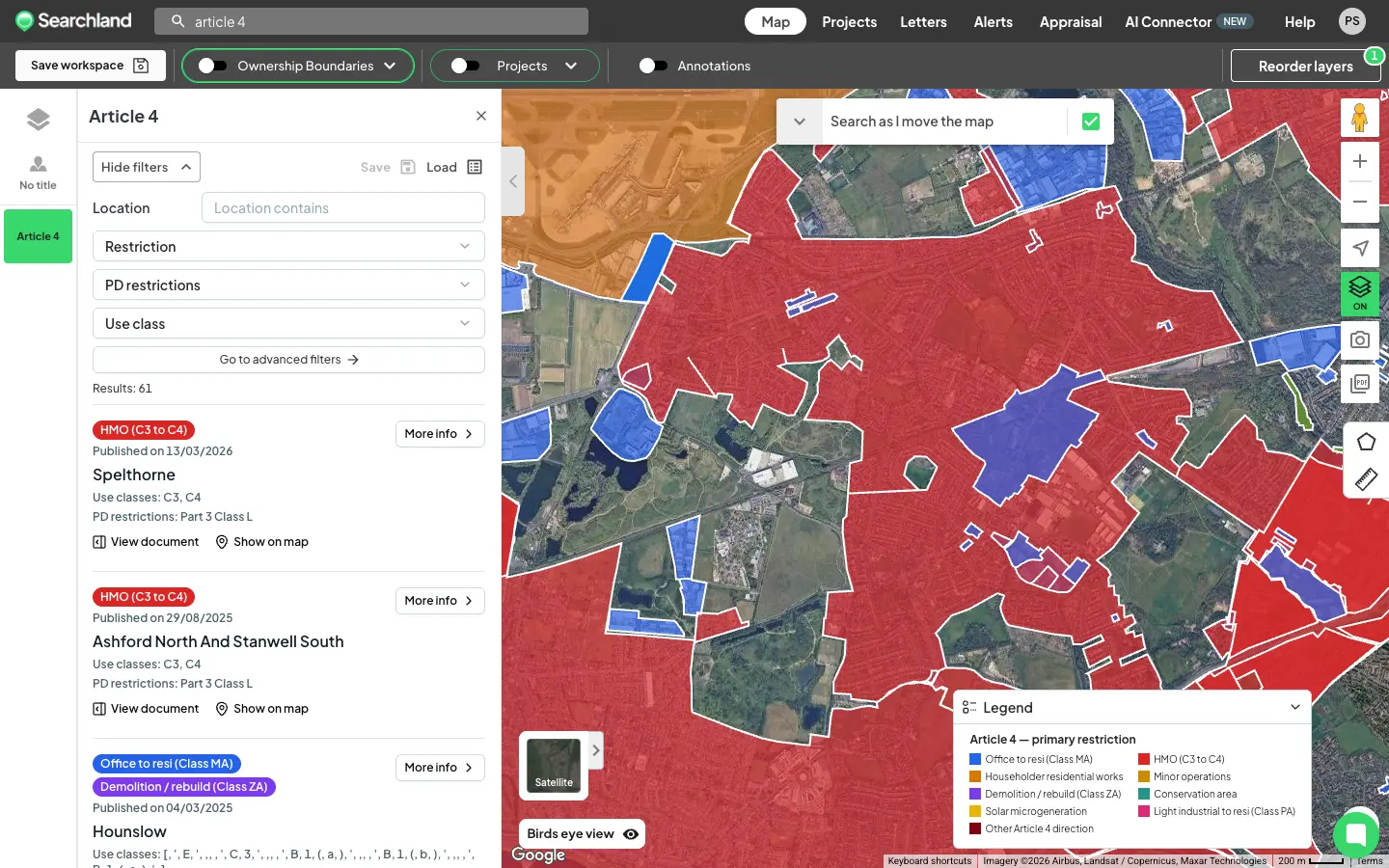
Article 4 Direction data on Searchland
Searchland's Article 4 dataset now supports:
- Searching by specific restriction type: HMO, office-to-residential, conservation area, and more
- Searching by specific permitted development right and referenced use class: find directions tied to a particular Class or Schedule reference
- In-platform document viewing: read the full schedule of a direction and see all related dates without leaving Searchland
- Full access via API and MCP, so the same data can be queried directly or connected into other tools and workflows
This sits alongside Searchland's wider planning constraints data, including Planning Enforcements, Neighbourhood Plans, Site Activity, Political Affiliations and Public Comments, giving a fuller picture of what can and can't happen on a site before time and money go into it.
See it live
Article 4 Direction data is live in Searchland now, searchable by restriction type and use class, with full schedules viewable in-platform and accessible via API and MCP.