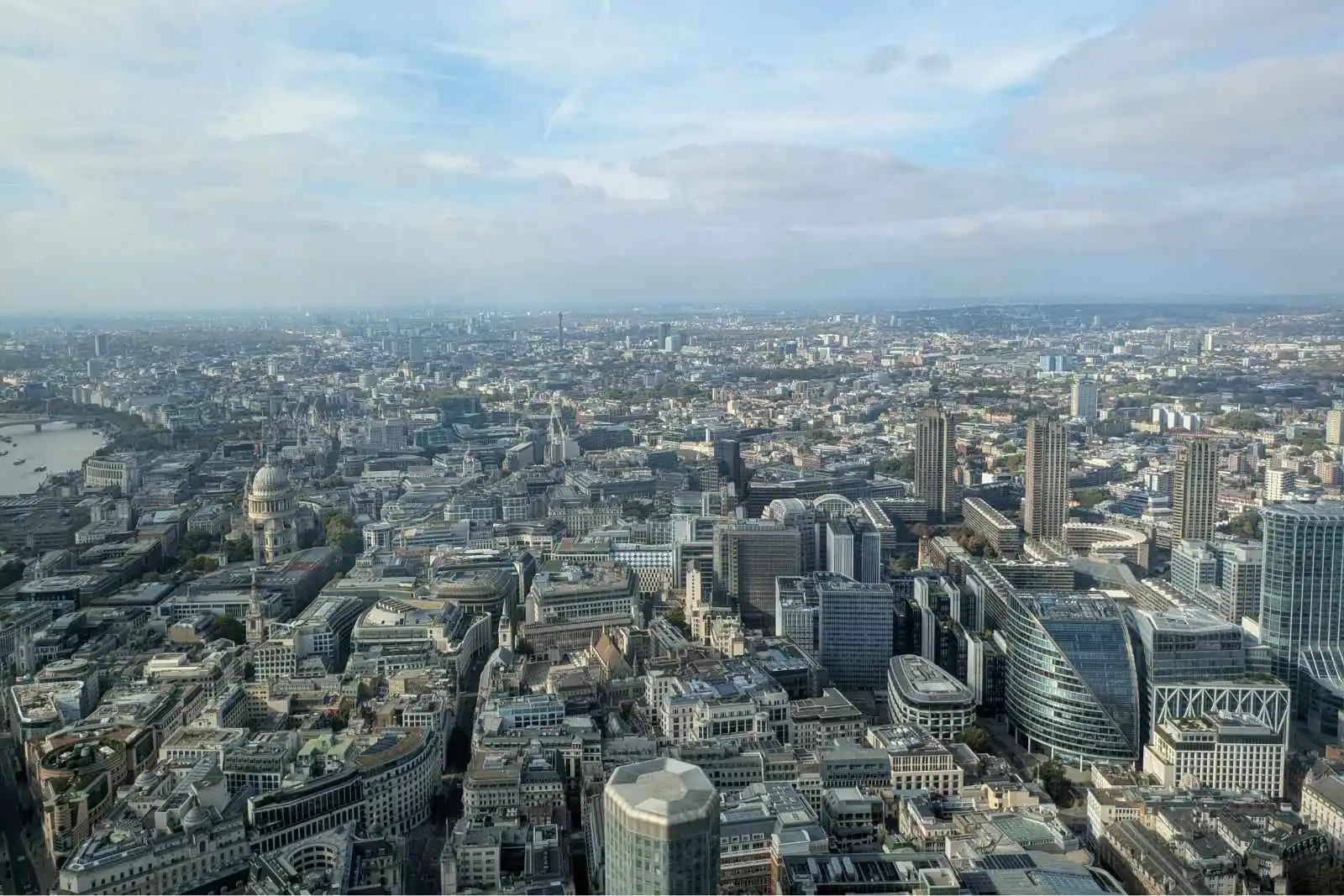
Vacant and half-let office blocks are now a familiar sight on the UK high street, and hybrid working hasn't reversed that. At the same time, England is still short of homes. For developers and agents, that gap between empty commercial stock and housing demand is where a conversion project starts to make sense.
Searchland exists to help find and assess those opportunities before a competitor does. This guide covers the two legal routes into a commercial to residential conversion, what changed in planning policy this year, and how to work out whether a given building stacks up financially.
Why commercial to residential conversion makes sense right now
Between 2015/16 and 2022/23, change-of-use permitted development rights delivered 102,830 new homes in England, 89% of them from office and commercial conversions (House of Commons Library). That's before the March 2024 changes that removed the size cap and vacancy requirement from Class MA, which should push the volume higher still.
The strongest opportunities tend to be secondary office locations, former banks and public buildings, and mixed-use sites where the ground floor retail has gone dark. Retail units in town centres remain a valid option. Check the Article 4 note below before assuming Class MA applies to yours.
How to convert commercial property to residential: two routes
Class MA permitted development
Class MA (introduced under the Town and Country Planning (General Permitted Development) (England) (Amendment) Order 2024, SI 2024/141) lets you convert a Class E commercial building to residential use without a full planning application. Since 5 March 2024, two of the old restrictions no longer apply:
- No size limit. The previous 1,500 sqm cap has gone, so larger office buildings now qualify.
- No vacancy requirement. The building no longer needs to have sat empty for three months before you apply.
What still applies: the building must have been in continuous Class E use for at least two years, and you'll need prior approval covering transport and highways impact, contamination, flooding, noise, natural light, and (for buildings over 18 metres or seven storeys) fire safety. Listed buildings, and sites in AONBs, SSSIs or National Parks, are excluded outright.
The change that matters most for this article: the NPPF, updated 17 August 2026, now explicitly encourages local authorities to use Article 4 directions to stop Class MA being used to strip out retail stock in town centres (Local Government Association). A growing number of councils already have Article 4 directions in place for this reason. Check the local authority's Article 4 register before assuming a high street unit qualifies, not after.
Full planning permission
Where Class MA doesn't apply, or the local authority has withdrawn it, you'll need a standard planning application. You'll need to show why the building no longer works commercially, how the scheme meets local housing need, and how it manages impact on neighbouring properties. Historic or conservation area buildings will usually bring the conservation officer in early.
One change worth building into your appraisal: the August 2026 NPPF reinstated the Vacant Building Credit, which reduces a scheme's affordable housing contribution in proportion to the floorspace of the vacant building being redeveloped (Local Government Association). This only applies to the full planning route. Class MA schemes carry no affordable housing requirement anyway.
Technical checklist for commercial to residential conversions
Converting commercial buildings isn’t a simple process. It’s more than just new walls and windows. Modern residential standards require careful consideration of several key areas:
- Fire safety: protected escape routes, adequate detection, emergency service access, and sprinklers where required.
- Sound insulation: floor and ceiling construction, party wall treatment, and mitigation for external and building services noise.
- Energy efficiency: window upgrades, insulation to current standards, and appropriate heating and cooling systems.
Pro tip: Early engagement with building control can help identify practical solutions that balance performance with cost.
How to calculate the financial viability of a commercial conversion
Now let’s talk about the money. If the numbers don’t work, your project is dead before it’s even started. Here's what you need to factor in when assessing the profitability of a conversion:
Development Costs to model:
- Purchase and acquisition (including taxes and fees)
- Construction
- Professional fees (architects, engineers, surveyors)
- Finance costs
- Planning obligations and Community Infrastructure Levy (CIL)
- Contingency (10% minimum is the usual rule of thumb)
Revenue Potential: Understanding local market values is crucial. Look at:
- Recent sales of similar converted properties
- New build values in the area
- Rental yields if you're planning to hold
- Potential premiums for character features
- Local market trends and projections
How to find off-market commercial properties ready for conversion
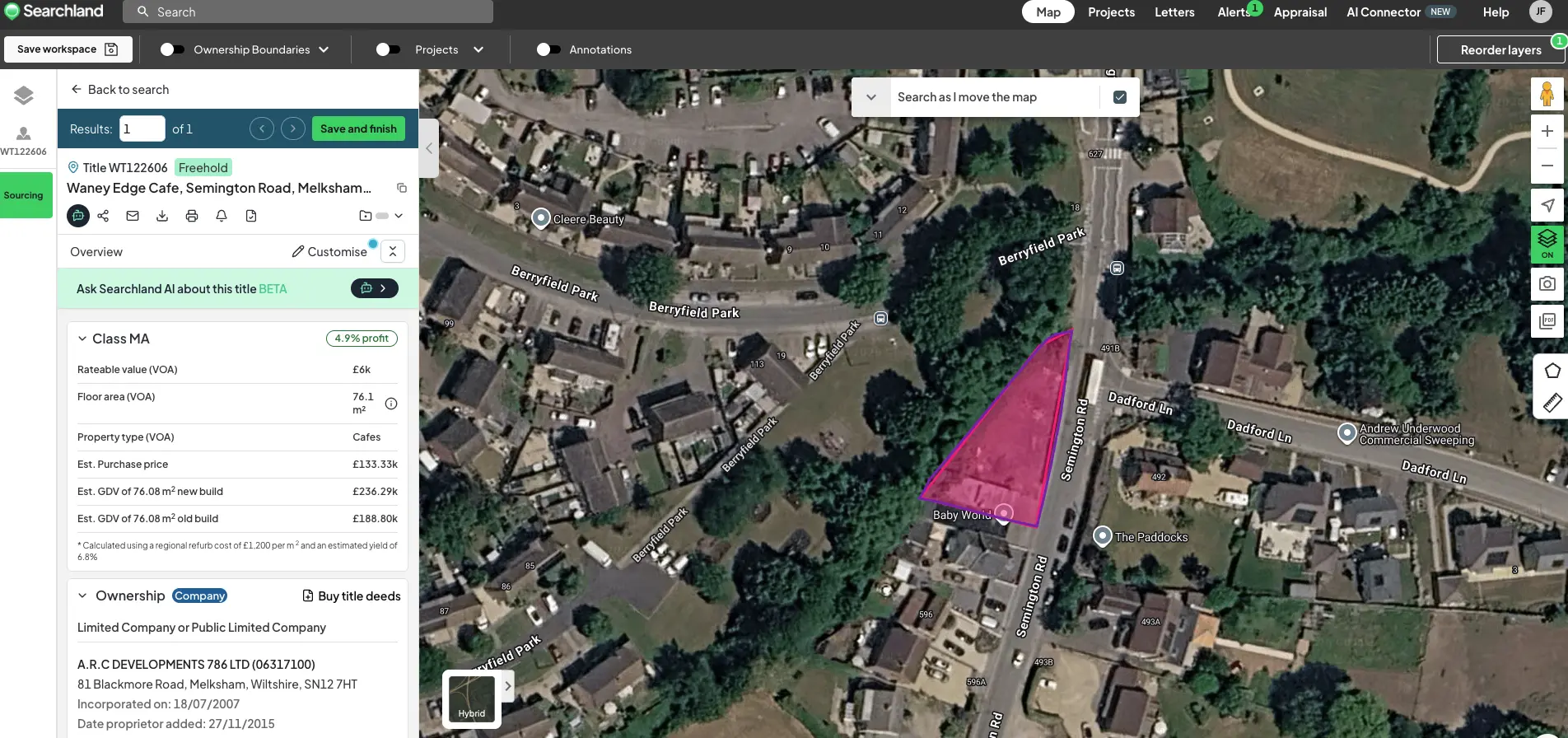
Finding hidden gems used to be about driving around neighbourhoods and manually trawling through planning data. Thankfully, modern technology has made the process much simpler and quicker. Using Searchland's platform, you can:
- Map vacant commercial properties across your target area
- Check planning histories and constraints instantly
- Assess local market conditions with our comprehensive data layers
- Find ownership details for off-market approaches
- Track similar conversions in the area
Read how VirginLand scaled to 500+ sites sourced a month using Searchland.
Top tips for a successful commercial to residential conversion
- Start with thorough due diligence, including an Article 4 check before you assume Class MA applies.
- Design smart. Room layouts and specification decisions made early are far cheaper to change than ones made after construction starts.
- Future-proof the development, particularly on energy performance, given where regulation is heading.
- Watch the costs that don't show up in the first estimate: structural issues, service upgrades, asbestos removal, and planning obligations all tend to surface late.
- Keep an eye on local Article 4 activity. More councils are adding directions since the August 2026 NPPF changes, and a site that qualifies for Class MA today may not next year.
Where commercial to residential policy is heading
The direction of travel since the August 2026 NPPF update is clearer protection for town centre retail alongside continued support for housing delivery elsewhere. Local plans now need to allocate at least 10% of housing to small sites and 10% to medium sites, which should open up more mid-size commercial conversion opportunities outside the areas being protected by Article 4.
Ready to find your next commercial to residential conversion?
Automated Site Sourcing is a Standard feature. It's the fastest way to find commercial buildings likely to qualify for conversion before they're marketed, cutting across ownership, planning history and Article 4 status in one search. See how Automated Site Sourcing works, check pricing, or book a demo.
Want to explore more development opportunities? Check out our guide on building a profitable HMO portfolio.