


If you're bringing a site through planning in England, biodiversity net gain (BNG) is something you plan for from day one, not a condition you deal with after permission is granted. In short: BNG is a legal requirement for most developments to leave the natural environment measurably better than they found it, a minimum 10% increase in biodiversity value, calculated using a government-set metric and secured for at least 30 years.
Knowing that definition only gets you so far, though. What matters more if you're appraising sites or running a viability model is what BNG actually costs, who it applies to, where the exemptions genuinely help, and how to get a credible number early enough to act on it. That's what this guide covers.
What biodiversity net gain actually means
BNG means a development can't just avoid harming habitats, it has to leave the site with more wildlife value than it started with: more grassland, more hedgerow, more genuine habitat, measured in a standard biodiversity unit rather than a vague "it looks greener now". The rule comes from the Environment Act 2021 and became compulsory from February 2024 for major development, and April 2024 for minor and small sites. Whatever gain you deliver has to stick around too: at least 30 years of upkeep, locked in through a planning condition, a Section 106 agreement, or a conservation covenant.
It's assessed through planning, not building regulations: your Biodiversity Gain Plan usually has to be approved before you can break ground.
The metric: how your 10% actually gets measured
The biodiversity net gain metric does the maths behind that 10% figure: the UK Habitat Classification scores a site on type, size or length, distinctiveness (low to very high), condition, and strategic significance. You, or more often your ecologist, run the statutory biodiversity metric calculation tool before development and after, and the gap has to clear 10%. It's maintained by Natural England, and Defra is moving it from a spreadsheet to a digital service during 2026. That completed calculation is one of the things that goes into your Biodiversity Gain Plan, covered below.
Two things that trip developers up:
- Timing: survey results shift with the seasons, so a site checked in December can score differently to the same site checked in June.
- Size doesn’t equal value: A small area of rich habitat, like species-rich grassland, can cost more units to replace than a much bigger area of poor habitat, like an amenity lawn. That's why getting your baseline right early matters more than how big the site is.
Who BNG applies to, and who's exempt
BNG applies to almost all planning applications in England from February 2024. Fewer developments are exempt than people think:
- Householder applications: extensions, conversions, and similar work to an existing dwelling.
- Permitted development: most work under Section 59 rights rather than a full application.
- De minimis impacts: small changes affecting under 25m² of habitat, or 5m of hedgerow or similar, unless it's a priority habitat.
- A handful of specific cases: urgent Crown development, biodiversity gain sites themselves, and HS2.
Three things changed in 2026. Since August, small sites under 0.2ha are exempt (as long as they don't affect priority habitats), short-term permissions of five years or less are exempt too, and smaller developments no longer have to try on-site options before off-site ones: they can pick whichever suits. Big infrastructure projects (NSIPs) joined the rules in November 2026, but only for the habitat they actually affect.
Outside that 0.2ha rule, there's still no general exemption for small sites. And Scotland and Wales don't follow these rules at all: Scotland has its own policy, and Wales is working on its own approach.
Delivering your 10%: units, credits, and the register
There are three ways to hit your 10%, and they carry different costs and risks.
On-site units come from habitat you create or enhance yourself: good for amenity value, but with a 30-year management bill to plan for. That bill often lands on future occupants through service charges, and some councils cap what can be charged, which shifts the cost back onto you instead. Housing associations and landscaping teams aren't always equipped to manage biodiversity-focused land either, and if your scheme is phased, each phase brings its own separate 30-year commitment, so costs and complexity stack up fast.
Off-site units are bought from a habitat bank and logged on the government's Biodiversity Gain Site Register. They're typically priced all-in, so it's easier to budget, but the market is still maturing. Units outside your local area can mean a costly spatial risk multiplier*, and legal readiness varies a lot by provider, with some habitat banks still carrying unresolved Section 106 agreements.
Statutory credits, sold by the government, are the last resort, priced deliberately high to discourage use.
Off-site prices vary by habitat type and distinctiveness, though on average, each biodiversity unit costs around £30,000. Treat any figure you're given as a starting point, not a quote.
What a BNG assessment or plan actually involves
A biodiversity net gain assessment usually goes through the following steps. First, a desk study of existing habitat data. Then a field survey to check what's actually there and what condition it's in. Next, a metric calculation to set your baseline. Then a plan for how you'll hit your 10%, whether that's on-site, off-site, or a mix of both. And finally, a monitoring plan covering the 30-year commitment.
Looking at reports actually submitted since BNG became mandatory, a few common patterns show up. Most contain:
- an introduction, covering site location, site description, and the development proposal
- a methodology section, covering habitat assessment (desktop and field studies) and an overview of the metric and its calculations
- a habitat overview, covering distinctiveness, condition, and the metric calculation's conclusion
- proposals for created habitats and the net gain assessment, covering on-site proposals, off-site proposals, or a BNG unit offset, whichever applies
- a habitat management section, covering plans for the mandatory management period
Most also come with plenty of visual aids: site photographs, and plans showing existing habitats against the proposed on-site improvements.
Submitting more than the bare legal minimum here tends to make validation smoother.
Once permission is granted, that draft becomes a full Biodiversity Gain Plan: finalised gains, the legal agreements behind them, and detailed habitat creation and monitoring plans. This has to be approved before work starts on site.
Most developers bring in an ecologist or BNG consultant to do this, and beyond a small site, that's the right call. A Biodiversity Gain Plan is a statutory submission, so a wrong baseline is expensive to fix later. Getting it right early also pays off beyond compliance: a site with clear biodiversity potential tends to move through planning faster, good early data reduces the risk of a costly redesign or refusal, and it gives you something concrete to show investors and local authorities on ESG. Earlier-stage tools are useful before that point: they give you a realistic read on habitat value and cost, so you can appraise a site properly before commissioning a full survey.
It's also worth talking to your local planning authority early. Interpretation of BNG requirements isn't always consistent between councils, so an early conversation can clarify what yours will actually expect and head off costly delays later. DEFRA and Natural England both publish guidance if you need a steer on the detail.
Where Searchland and GAIA come in
BNG is easy to research in theory and hard to price at the point that matters. A full ecological survey can take weeks, depending on the season, and comes with real cost, so it's hard to justify before you've even decided a site is worth pursuing. That's a particular problem if you're comparing several sites at once and need a quick read on all of them, not just the one you eventually commit to.
Searchland partners with GAIA, the UK's leading BNG marketplace, to bring habitat and off-site unit data straight into the land-sourcing platform:
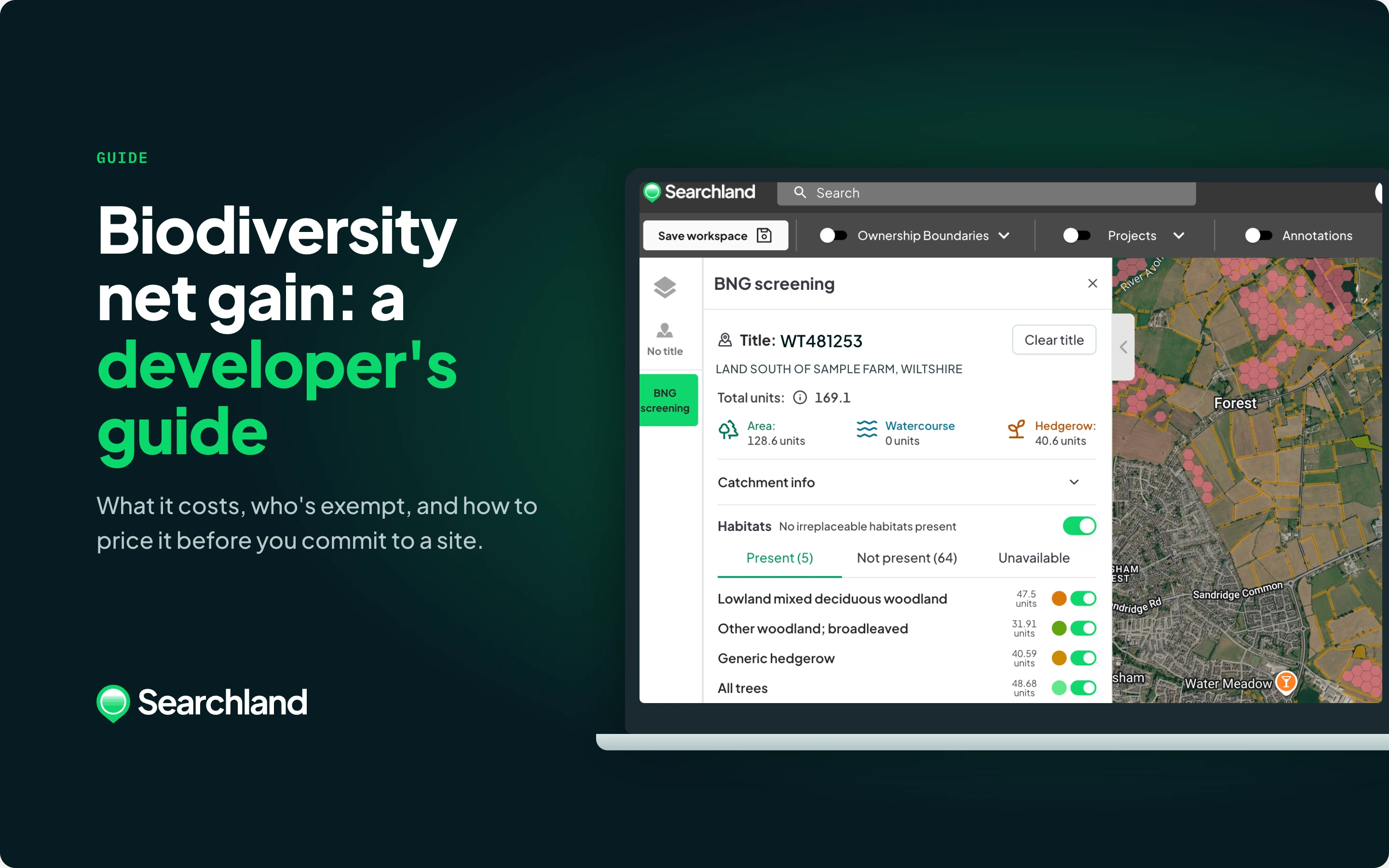
- BNG Screening: shows likely habitat types, unit counts, and a health check, before you commit to a full survey.
- BNG Listings: GAIA's marketplace of accredited off-site units, without leaving Searchland.
- BNG Sourcing: surfaces off-market habitat bank opportunities.
- BNG Habitats: a map view of habitat and BNG data across your search area.
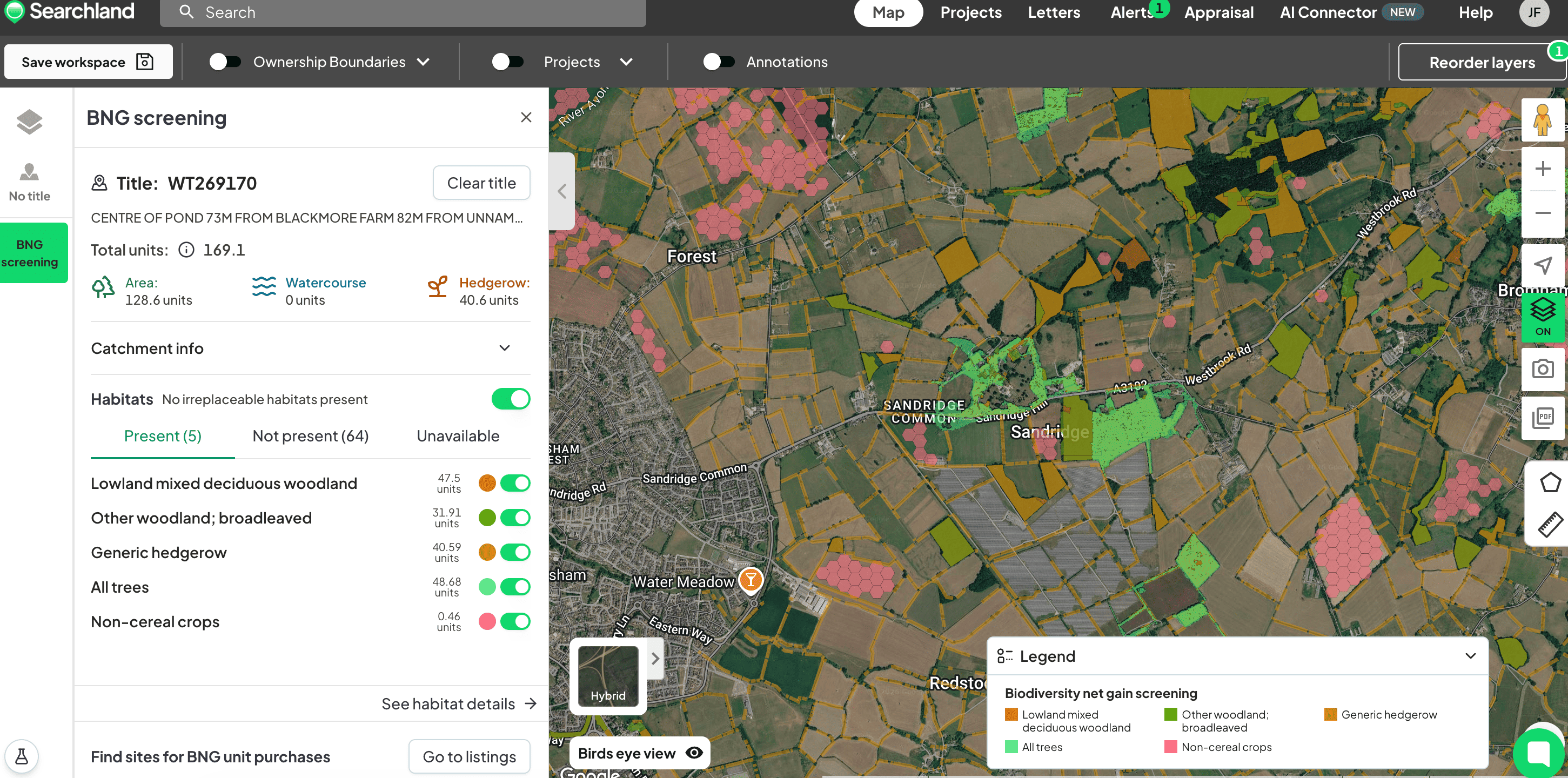
This doesn't replace your ecologist or consultant: a Biodiversity Gain Plan still needs a qualified professional behind it. It just stops BNG being a surprise, by putting baseline data and rough cost in front of you early enough to walk away or reprice.
Biodiversity Net Gain is a Pro and Max plan feature, bringing all four tools together in the platform you already use to source land. All the BNG tools you need, in one place, plans for every user, or book a demo.
FAQ’s
What happens if you don't comply with BNG?
Without an approved Biodiversity Gain Plan, development generally can't lawfully commence. Breaching it afterwards is a breach of planning control, enforceable like any other condition. In practice, non-compliance usually shows up earliest as delay, a weak plan gets challenged at validation or refused outright.
What's the difference between a BNG unit and a BNG credit?
A unit comes from real habitat, created or enhanced on-site or bought from a habitat bank. A credit is bought directly from the government, deliberately priced high, and only available as a last resort. Credits should only come into play once units are off the table.
*What's a spatial risk multiplier?
A penalty built into the metric for off-site units sourced further from your site. Units close by carry the smallest risk premium; units from further afield need to be bought in greater volume to count the same towards your 10%.
What tools can help with early BNG assessment? Searchland partners with GAIA to bring habitat screening, off-site unit listings, sourcing, and mapped habitat data into the same platform you already use to source land, so you get a realistic read on habitat value and cost before committing to a full survey. It's a Pro and Max plan feature, and it doesn't replace your ecologist or consultant: you'll still need a qualified professional behind the Biodiversity Gain Plan itself.




_1%252520(1).jpeg)

