Our team of property and land experts are constantly analysing news from governments and industry leaders. We compile all our insights into one place.
Stay up-to-date with permitted development changes, new legislation and market movements.
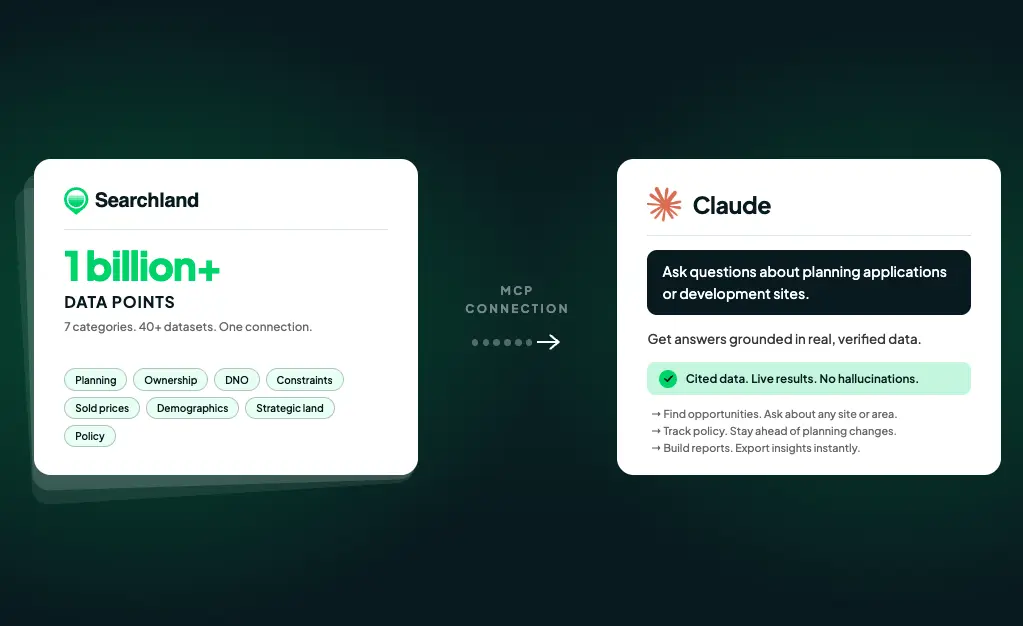
Connect Claude, ChatGPT, or Microsoft Copilot directly to live UK planning and land data — ownership records, planning history, constraints, live applications - and get sourced answers instead of hallucinated ones. Setup takes about five minutes. No developer needed.
Whether you are embarking on new construction projects near safeguarded radar or surveillance sites, or building at height - you might be interested in the planning constraints you could face. Our new National Air Traffic Service tool has you covered.
Discovering the ideal site in the perfect location is now more effortless than ever. Introducing the brand-new Proximity feature, designed to empower users with precise location insights. Now users can easily find sites based on their proximity to key amenities.
As a property developer, finding the right location is key to the success of your project. Access to critical amenities like roads, bus and rail infrastructure and more recently, EV chargers, can be the deciding factor when it comes to making a decision.
Ever wondered what stands between an idea for a new building and its actual construction? It's the world of planning applications—a critical, yet often complex, part of property development. These applications are more than just paperwork; they're the keys that can unlock your project's potential or put it on hold.
As the UK grapples with varying weather conditions, the necessity for accurate flood risk assessment has never been more evident. We’re enhancing our land-sourcing tools with the expansion of our flood data coverage into Wales and Scotland.
The fundamental aim of Green Belt policy is to prevent urban sprawl by keeping land permanently open. But could rethinking Green Belt policy be the key to solving our housing crisis?
MCP is the new standard letting AI assistants talk to your data. Here's what it means for site assessment, sourcing, and planning appraisals.
Searchland analysis reveals 823,574 potential homes near train stations in England, highlighting where development could be prioritised under proposed NPPF reforms - and how policy shifts could reshape land sourcing strategies.
Major housing schemes now take over 300 days to get planning approval - a 75% increase in a decade - highlighting that delays, not refusals, are the real bottleneck in the UK planning system.
Searchland has a clear mission: to transform the way property professionals source sites. Here's the full story on where we come from and how we're helping developers across the UK.
The Renters Reform Bill presents the biggest shake-up England’s private rented sector has seen in decades. Expected to pass in 2025, Build to Rent (BTR) and Private Rented Sector (PRS) developers will need to rethink everything from unit design and management strategies to how they navigate the planning process.
Searchland’s inbuilt DTV mailmerge tool helps you to automate the whole process of sourcing off market land and contacting landowners, from start to finish, all on one platform. But how to start to write the content of the letter? Read our guide on how to write on point DTV mailmerge letters, designed to get your message across effectively, and maximise the chances of a positive response from a vendor.
MCP is everywhere right now. But not all connectors are built the same - and in property and planning, the difference shows up fast. Here's what to look for, and how Searchland stacks up.
Proposed NPPF reforms could introduce a “default yes” approach to development near train stations. We’ve analysed 1,000+ locations across England to identify where the biggest opportunities sit - and how to get ahead before policy is finalised.
Sourcing and appraising development land in the UK requires using multiple site sourcing tools, from checking land ownership and planning history to assessing flood risk, environmental constraints, and site boundaries.
Padel court development is booming across the UK, with planning applications up 113% in 2024. At Searchland, we've uncovered nearly 17,000 sites ready for padel investment. Here's where the real opportunity lies for landowners, developers and investors.
The UK’s Clean Power 2030 target—95% low-carbon electricity by the end of the decade - is reshaping the renewable energy landscape. But with grid congestion, planning hurdles, and soaring land competition, sourcing the right sites has never been tougher.
Well things have certainly changed since we wrote this article in early 2024. Not only do we now have a new Labour-led government but some huge changes to energy policy too. We'll keep the old stuff here for preservation and update the story as it develops.
Every public EV charger in the UK, now on your map - powered by Zapmap. Colour-coded by speed, built into sourcing. The first PropTech platform to bring it in.
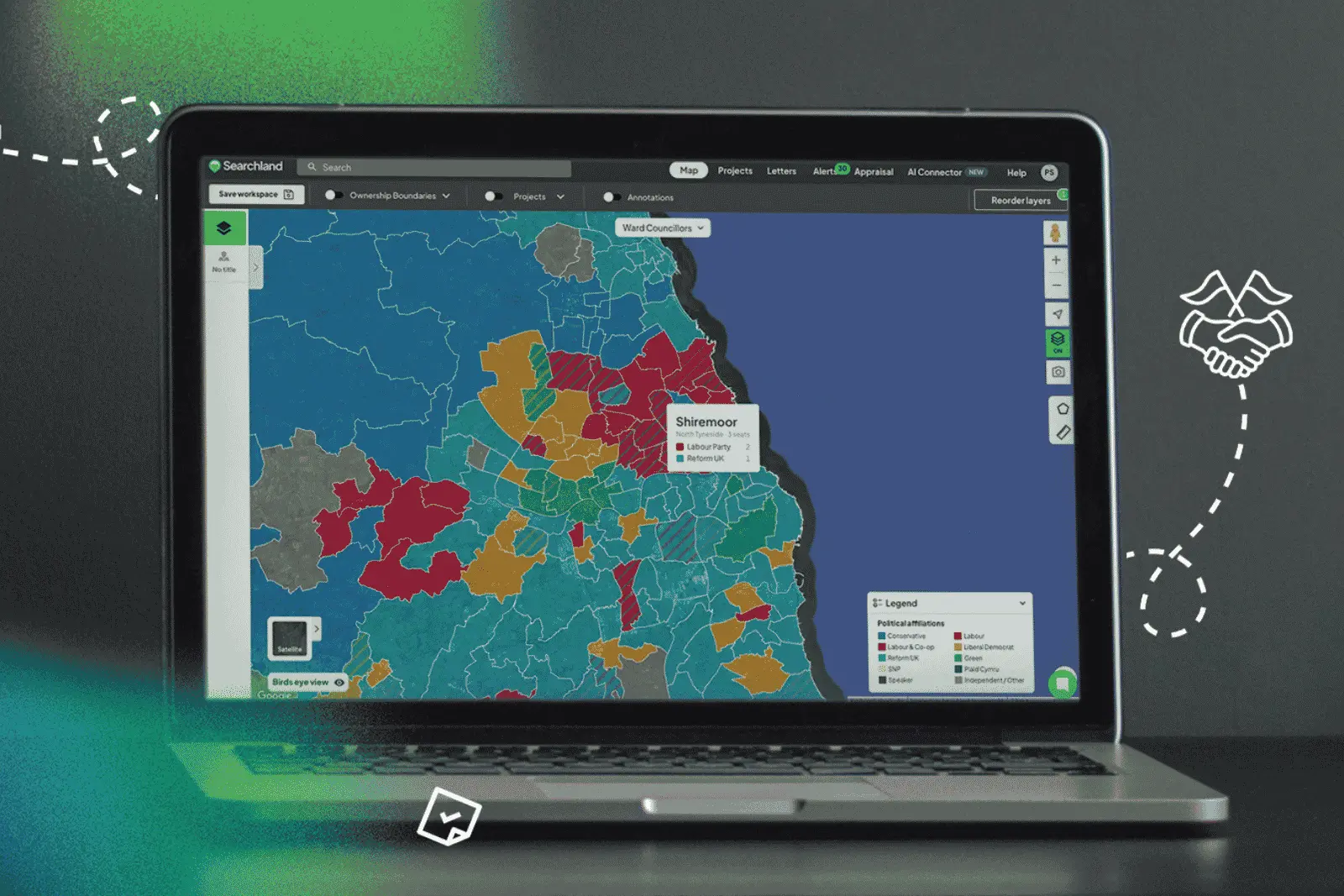
Searchland now maps the political make-up of every constituency, ward and district across England, Wales and Scotland - so you can read the local political climate before you commit to a site.
Searchland now brings together over 3,000 Neighbourhood Plans across 300+ councils - surfacing hyper-local policy directly on the map, so site risk is visible from the very first click.
What happens after planning approval? This update shows stakeholder comments, objections and real-world site activity, helping you track whether developments are built, stalled or completed.
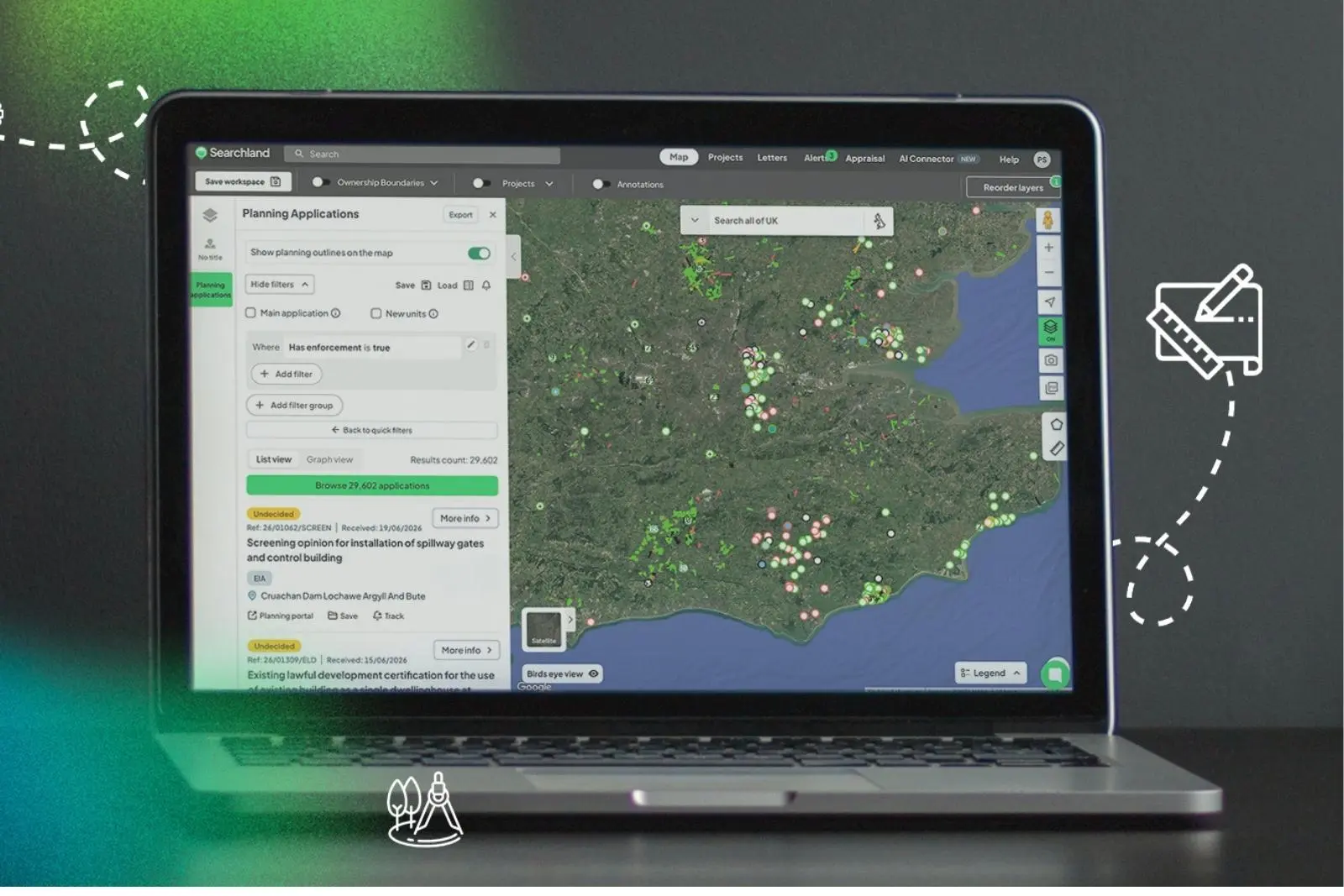
Searchland’s Planning Tool brings together 23 million+ UK applications into one searchable, filterable, map-based platform - so land and planning teams can quantify authority behaviour, assess risk properly, and move with confidence instead of instinct.
Developers move fastest when data, insight, and decisions live in one place. Searchland’s new appraisal tool delivers exactly that - turning the entire acquisition workflow into a single, seamless motion.