Our team of property and land experts are constantly analysing news from governments and industry leaders. We compile all our insights into one place.
Stay up-to-date with permitted development changes, new legislation and market movements.
See the charge code, lender, and secured debt behind any company on Searchland's ownership page — built for due diligence, refinancing, and acquisition prospecting.
Discover the six Biodiversity Net Gain (BNG) takeaways developers should understand in order to reduce negative impacts on developments, whilst complying with the new policy.
As the UK’s transition to a low-carbon economy continues, the demand for reliable, flexible energy storage solutions has never been greater. Battery Energy Storage Systems (BESS), play an important role in balancing the grid, integrating renewable energy, and ensuring a stable power supply.
Build to Rent (BTR) has emerged as a major force in the UK property market. BTR’s surge in popularity is driven by changing demographics, shifting attitudes towards homeownership, and a growing demand for high-quality rental homes. The BTR rental sector is attracting billions of pounds in investment from developers and institutions alike.
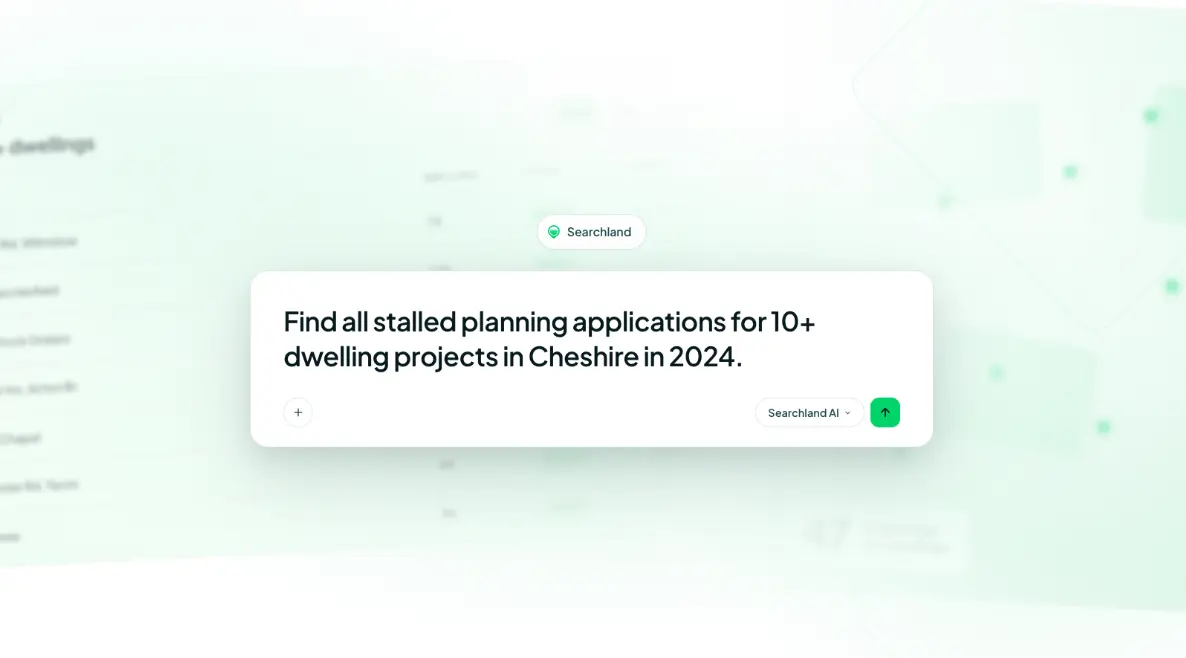
Ask Searchland what you're looking for in plain language, and let the AI Sourcing Assistant translate that into the right filters and results.
See a company's ownership tree, directors, and the land or property it owns - Companies House data built directly into Searchland.
Biodiversity Net Gain policy is now mandatory for most development projects in England. But what does a good BNG report look like, what projects are being approved or rejected and what BNG solutions are developers proposing?
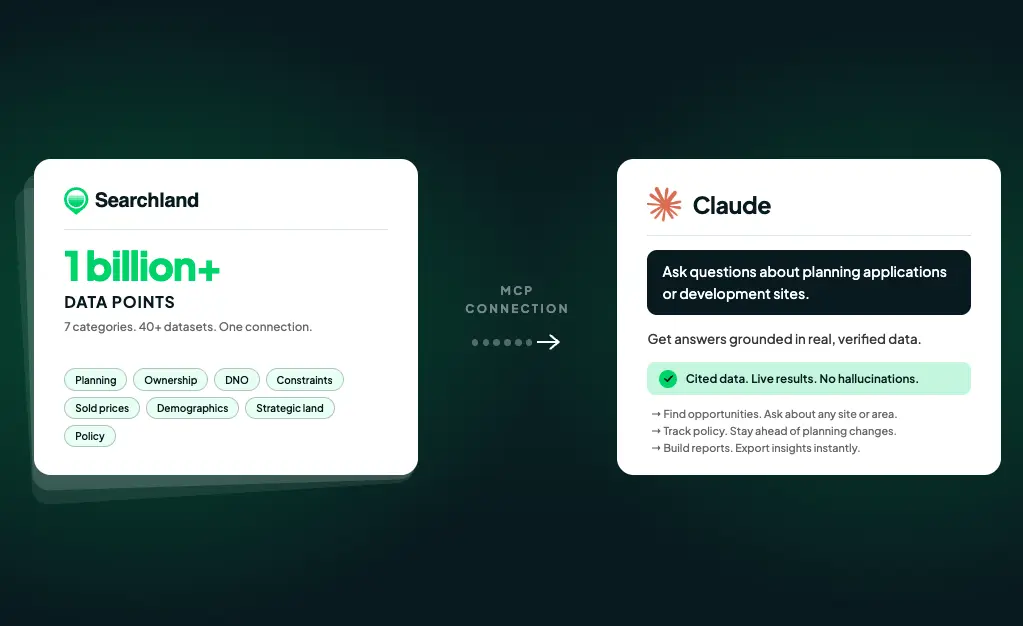
Connect Claude, ChatGPT, or Microsoft Copilot directly to live UK planning and land data — ownership records, planning history, constraints, live applications - and get sourced answers instead of hallucinated ones. Setup takes about five minutes. No developer needed.
MCP is the new standard letting AI assistants talk to your data. Here's what it means for site assessment, sourcing, and planning appraisals.
Searchland analysis reveals 823,574 potential homes near train stations in England, highlighting where development could be prioritised under proposed NPPF reforms - and how policy shifts could reshape land sourcing strategies.
Major housing schemes now take over 300 days to get planning approval - a 75% increase in a decade - highlighting that delays, not refusals, are the real bottleneck in the UK planning system.
Searchland has a clear mission: to transform the way property professionals source sites. Here's the full story on where we come from and how we're helping developers across the UK.
The Renters Reform Bill presents the biggest shake-up England’s private rented sector has seen in decades. Expected to pass in 2025, Build to Rent (BTR) and Private Rented Sector (PRS) developers will need to rethink everything from unit design and management strategies to how they navigate the planning process.
With difficulties obtaining planning permission on the Green Belt could Labour's plans for development of the so-called ‘Grey Belt’ provide the land needed to deliver on housing targets in the UK?
UK planning application approval rates by local authority from 2011–2026 - including live 2026 decisions. Compare councils, trends and sectors in one national view.
Permitted development rights allow certain types of development to proceed without full planning permission. Learn how they work and why they matter for developers.
A practical guide to the call for sites process, explaining how councils assess land and how developers use CFS to build long-term pipeline.
Class R rules changed in May 2024, expanding the commercial uses allowed on agricultural units. Understand what’s now permitted and how to assess viable opportunities.
Class Q allows agricultural buildings to be converted into up to 10 homes without full planning permission. Learn the rules, limits, and how developers are sourcing opportunities today.
How a specialist block agency finds off-market MUFBs: the ownership, leasehold and EPC filters used to source unsplit multi unit freehold blocks.
Sourcing a site is only half the job - the other half is getting a lender comfortable with the numbers. We hosted a webinar with Andrew Fraser, Chief Commercial Officer at Assetz Capital, to break down exactly how an agile lender's credit team assesses a deal, from first read to term sheet.
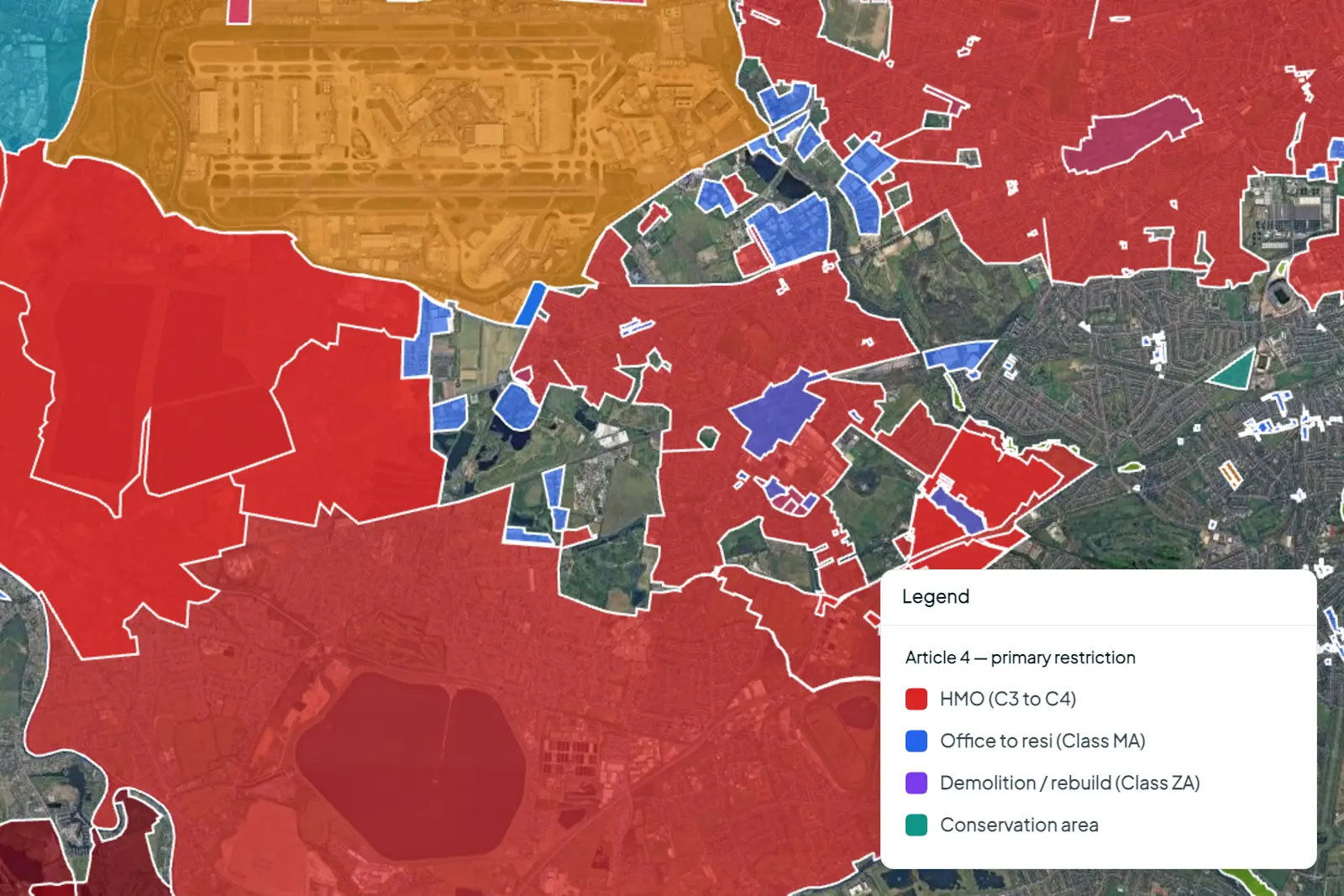
Article 4 Directions quietly withdraw permitted development rights, and they cover the majority of England's councils. Searchland's Article 4 data is now searchable by restriction type, PD right and use class.
MCP is everywhere right now. But not all connectors are built the same - and in property and planning, the difference shows up fast. Here's what to look for, and how Searchland stacks up.
Proposed NPPF reforms could introduce a “default yes” approach to development near train stations. We’ve analysed 1,000+ locations across England to identify where the biggest opportunities sit - and how to get ahead before policy is finalised.
Sourcing and appraising development land in the UK requires using multiple site sourcing tools, from checking land ownership and planning history to assessing flood risk, environmental constraints, and site boundaries.
See ECR, DNO and NESO generation data on the map - assess what's already connected before you commit to a site.
See ONS census data - population, age, income and household composition - for any site on Searchland, without leaving the platform.
Search live and completed commercial sales and lettings - industrial, retail, office and land - with comparables and lease history built in.
See Tree Preservation Orders (TPOs) for any site across England, Wales and Scotland, directly on the map - before they become a planning problem.