Our team of property and land experts are constantly analysing news from governments and industry leaders. We compile all our insights into one place.
Stay up-to-date with permitted development changes, new legislation and market movements.
Commercial to residential conversion got easier once Class MA's size and vacancy rules were scrapped in 2024. Here's how the process and costs work now.
What makes a good BESS site? Grid capacity, land type, size and planning policy - and how Searchland helps you find battery storage sites faster.
The most successful property developers have one thing in common. They all know how to find the best opportunities before they hit the market. In today’s competitive property landscape, waiting for properties to be listed publicly often means missing out on the best deals.
What biodiversity net gain actually means for developers: the 10% rule, the metric, exemptions, units and credits, and how to budget for it with confidence.
Learn how to value development land using residual value, comparable evidence and benchmark methods - including a worked GDV example and the tools that make land valuation more accurate.
Property site sourcing means finding development land before competitors do. See four proven off-market strategies developers use to secure sites first.
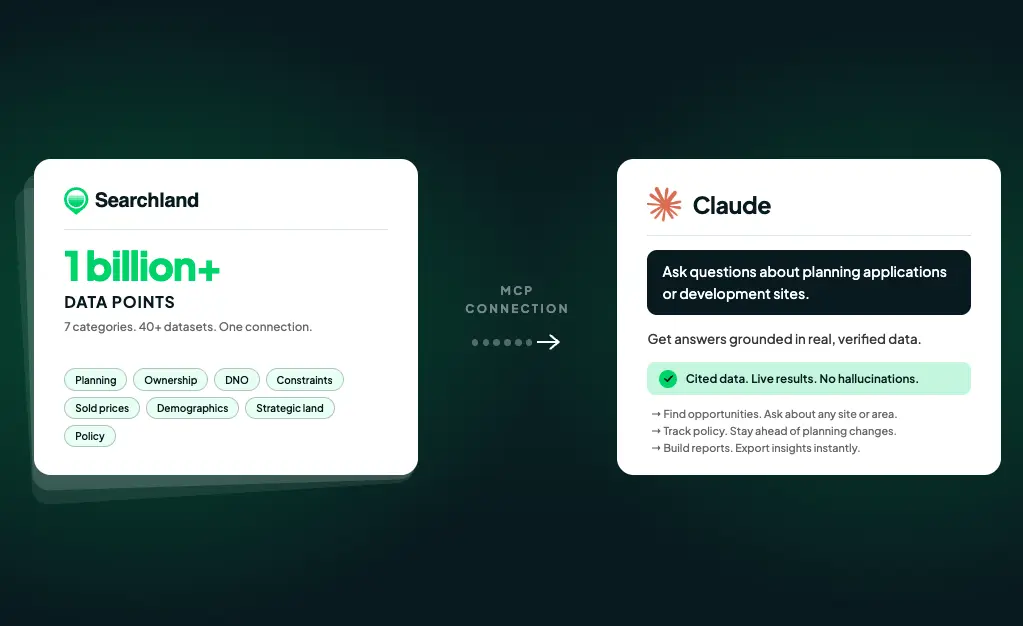
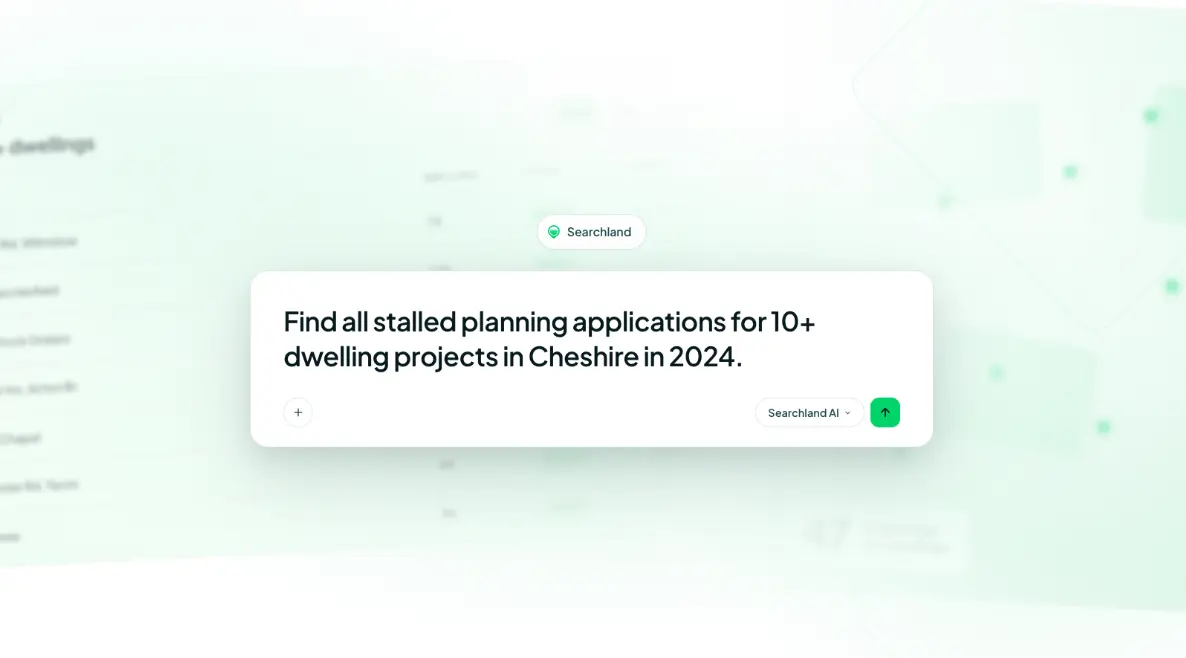
Connect Claude, ChatGPT, or Microsoft Copilot directly to live UK planning and land data — ownership records, planning history, constraints, live applications - and get sourced answers instead of hallucinated ones. Setup takes about five minutes. No developer needed.
MCP is the new standard letting AI assistants talk to your data. Here's what it means for site assessment, sourcing, and planning appraisals.
Searchland analysis reveals 823,574 potential homes near train stations in England, highlighting where development could be prioritised under proposed NPPF reforms - and how policy shifts could reshape land sourcing strategies.
Major housing schemes now take over 300 days to get planning approval - a 75% increase in a decade - highlighting that delays, not refusals, are the real bottleneck in the UK planning system.
Searchland has a clear mission: to transform the way property professionals source sites. Here's the full story on where we come from and how we're helping developers across the UK.
The Renters Reform Bill presents the biggest shake-up England’s private rented sector has seen in decades. Expected to pass in 2025, Build to Rent (BTR) and Private Rented Sector (PRS) developers will need to rethink everything from unit design and management strategies to how they navigate the planning process.
In the complex world of property development, we shine a light on the strategic role of appeals in planning applications and the transformative power of data. Discover how to turn the insights into your most valuable ally in creating a comprehensive planning appeals strategy.
Nutrient neutrality is a means of ensuring that a plan or project does not add to existing nutrient burdens so there is no net increase in nutrients as a result of the plan or project.
Sourcing land is a complex process with many factors to consider. To get the numbers right, it is important to be organised, efficient, and accurate. By following the best practices discussed in this blog, you can increase your chances of making a well-informed decision.
We've introduced AI (artificial intelligence) into Searchland, enabling you to find specific information about local council plan documents, adopted & emerging, within seconds.
In protected land areas, it’s a requirement to offset the nutrient pollution caused by new construction. Read how developers can purchase 'nutrient credits' or create nutrient mitigation schemes themselves to meet requirements.
Search for sites that qualify under Permitted Development rights - Searchland screens eligibility so you don't have to check each site by hand.
Sourcing and appraising development land in the UK requires using multiple site sourcing tools, from checking land ownership and planning history to assessing flood risk, environmental constraints, and site boundaries.
The UK’s Clean Power 2030 target—95% low-carbon electricity by the end of the decade - is reshaping the renewable energy landscape. But with grid congestion, planning hurdles, and soaring land competition, sourcing the right sites has never been tougher.
Well things have certainly changed since we wrote this article in early 2024. Not only do we now have a new Labour-led government but some huge changes to energy policy too. We'll keep the old stuff here for preservation and update the story as it develops.
Demand for electric vehicle charging sites is growing exponentially. Here we explore some of the best opportunities for developers, for building the future network of EV charge points in the UK.
The UK is facing a housing crisis of unprecedented proportions, with a deficit of 4.3 million homes and a projected increase in households to 26.9 million by 2043. To tackle this issue, Brickflow has released a white paper which delves deep into the problem and offers recommendations for a way forward.
All the planning approval rates and new build sales price information you need for the Kent Local Authority Districts.
Model residual land value, GDV, profit and cashflow for any site with Searchland's appraisal tool - built on the data already in the platform.
See the charge code, lender, and secured debt behind any company on Searchland's ownership page — built for due diligence, refinancing, and acquisition prospecting.
See planning enforcement notices against any application or title on Searchland - know who's breached planning rules before you commit to a site.
See every public EV charger in the UK on your map, powered by Zapmap - colour-coded by speed and built directly into site sourcing.
Searchland now maps the political make-up of every constituency, ward and district across England, Wales and Scotland - so you can read the local political climate before you commit to a site.