Our team of property and land experts are constantly analysing news from governments and industry leaders. We compile all our insights into one place.
Stay up-to-date with permitted development changes, new legislation and market movements.
See the charge code, lender, and secured debt behind any company on Searchland's ownership page — built for due diligence, refinancing, and acquisition prospecting.
With difficulties obtaining planning permission on the Green Belt could Labour's plans for development of the so-called ‘Grey Belt’ provide the land needed to deliver on housing targets in the UK?
How a specialist block agency finds off-market MUFBs: the ownership, leasehold and EPC filters used to source unsplit multi unit freehold blocks.
Sourcing a site is only half the job - the other half is getting a lender comfortable with the numbers. We hosted a webinar with Andrew Fraser, Chief Commercial Officer at Assetz Capital, to break down exactly how an agile lender's credit team assesses a deal, from first read to term sheet.
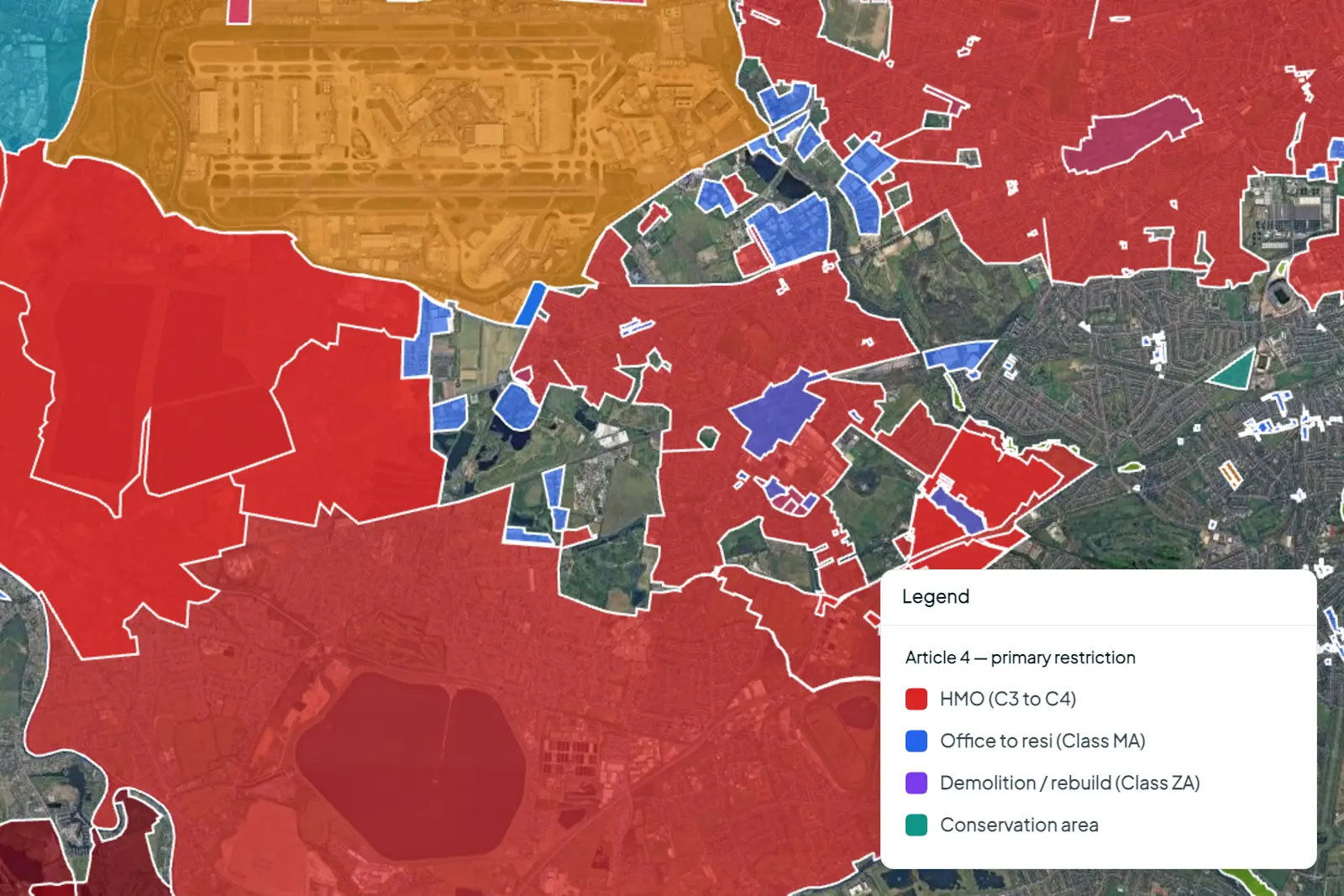
Article 4 Directions quietly withdraw permitted development rights, and they cover the majority of England's councils. Searchland's Article 4 data is now searchable by restriction type, PD right and use class.
See planning enforcement notices against any application or title on Searchland - know who's breached planning rules before you commit to a site.
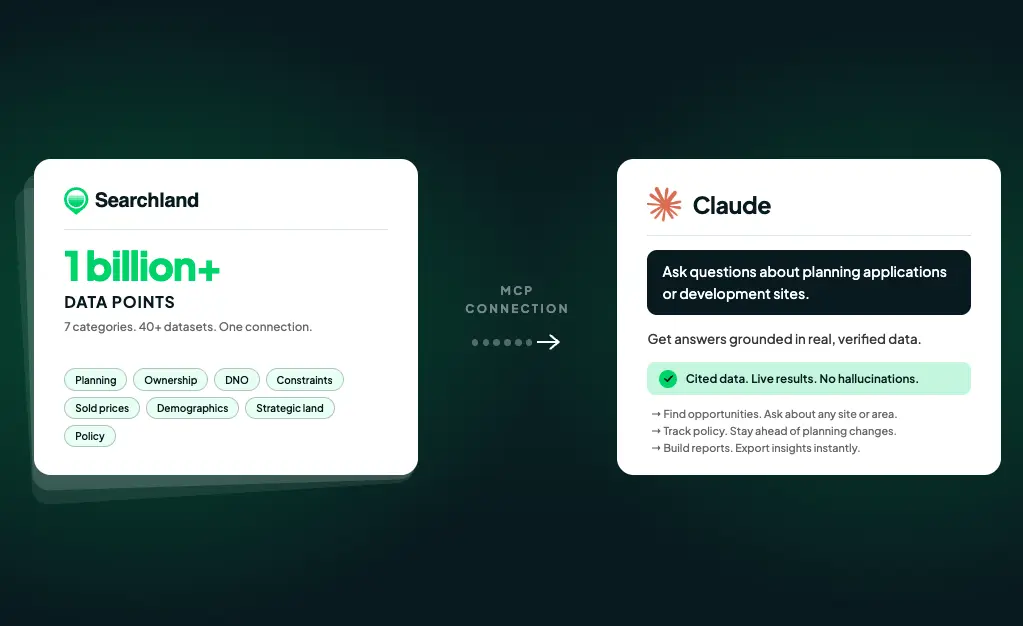
Connect Claude, ChatGPT, or Microsoft Copilot directly to live UK planning and land data — ownership records, planning history, constraints, live applications - and get sourced answers instead of hallucinated ones. Setup takes about five minutes. No developer needed.
MCP is the new standard letting AI assistants talk to your data. Here's what it means for site assessment, sourcing, and planning appraisals.
Searchland analysis reveals 823,574 potential homes near train stations in England, highlighting where development could be prioritised under proposed NPPF reforms - and how policy shifts could reshape land sourcing strategies.
Major housing schemes now take over 300 days to get planning approval - a 75% increase in a decade - highlighting that delays, not refusals, are the real bottleneck in the UK planning system.
Searchland has a clear mission: to transform the way property professionals source sites. Here's the full story on where we come from and how we're helping developers across the UK.
The Renters Reform Bill presents the biggest shake-up England’s private rented sector has seen in decades. Expected to pass in 2025, Build to Rent (BTR) and Private Rented Sector (PRS) developers will need to rethink everything from unit design and management strategies to how they navigate the planning process.
In the complex world of property development, we shine a light on the strategic role of appeals in planning applications and the transformative power of data. Discover how to turn the insights into your most valuable ally in creating a comprehensive planning appeals strategy.
Nutrient neutrality is a means of ensuring that a plan or project does not add to existing nutrient burdens so there is no net increase in nutrients as a result of the plan or project.
Sourcing land is a complex process with many factors to consider. To get the numbers right, it is important to be organised, efficient, and accurate. By following the best practices discussed in this blog, you can increase your chances of making a well-informed decision.
We've introduced AI (artificial intelligence) into Searchland, enabling you to find specific information about local council plan documents, adopted & emerging, within seconds.
In protected land areas, it’s a requirement to offset the nutrient pollution caused by new construction. Read how developers can purchase 'nutrient credits' or create nutrient mitigation schemes themselves to meet requirements.
Search for sites that qualify under Permitted Development rights - Searchland screens eligibility so you don't have to check each site by hand.
MCP is everywhere right now. But not all connectors are built the same - and in property and planning, the difference shows up fast. Here's what to look for, and how Searchland stacks up.
Proposed NPPF reforms could introduce a “default yes” approach to development near train stations. We’ve analysed 1,000+ locations across England to identify where the biggest opportunities sit - and how to get ahead before policy is finalised.
Sourcing and appraising development land in the UK requires using multiple site sourcing tools, from checking land ownership and planning history to assessing flood risk, environmental constraints, and site boundaries.
See surface water flooding risk for any site in the UK, directly on the map - a factor planning authorities increasingly expect you to address early.
See soil type, depth and peat coverage - Soilscapes data for any UK site, directly on the map.
Scotland-specific planning and land data is now on Searchland - the same depth of coverage as England and Wales, built into one platform.